About Caladenia minorata M.A.Clem.
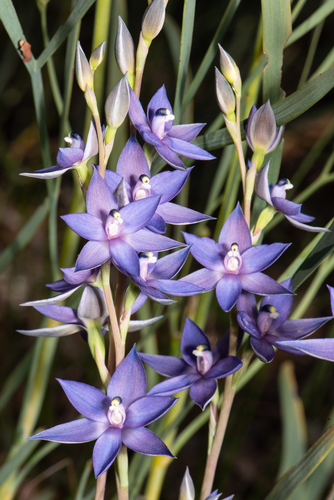
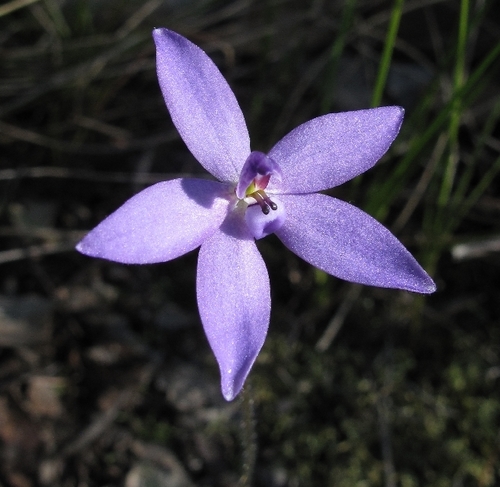
This species, previously described under the synonym Glossodia minor, is a terrestrial, perennial, deciduous herb that grows from an underground tuber. It produces a single dark green, very hairy, egg-shaped leaf that lies flat on the ground. The leaf measures 10–30 mm (0.4–1 in) long and 8–10 mm (0.3–0.4 in) wide. One deep violet-blue flower (rarely white) is borne on a stalk 40–160 mm (2–6 in) tall; the flower is 20–25 mm (0.8–1 in) long and wide. The outer surface of the sepals and petals is light-colored and hairy. The dorsal sepal is 12–15 mm (0.5–0.6 in) long and 3–5 mm (0.1–0.2 in) wide. The lateral sepals have the same dimensions as the dorsal sepal and spread apart from each other. The petals are 10–13 mm (0.4–0.5 in) long and 3–5 mm (0.1–0.2 in) wide, and spread widely. The labellum is shaped like an elongated heart, 4–5 mm (0.16–0.20 in) long and 2–3 mm (0.08–0.1 in) wide. It is bluish-purple with a white tip, and has a furrow near its base. At the base of the labellum are two large, club-shaped calli joined at their bases, each with a fleshy black top. Flowering occurs between July and October, and is more prolific after bushfire. Commonly called the small waxlip orchid, it is mainly found along the eastern coastline of Queensland, New South Wales and Victoria. In New South Wales it is most common in coastal heath, with records occurring as far west as Temora. In Victoria, it is mainly restricted to coastal grasstree plains in East Gippsland, though there are records from as far west as Wilsons Promontory.