About Caladenia longicauda Lindl.
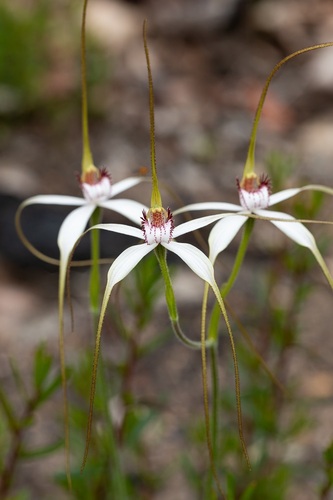
Caladenia longicauda Lindl. is a terrestrial, perennial, deciduous herb that grows from an underground tuber. It produces a single hairy leaf, which measures 100–250 mm (4–10 in) long and 5–20 mm (0.2–0.8 in) wide. Between July and early November, it bears one to three, sometimes up to five, flowers on a stalk that is 170–600 mm (7–20 in) tall. Each individual flower is 50–180 mm (2–7 in) wide. Flowers are mostly white, with only a few red markings and reddish stripes on the backs of the petals and sepals. The dorsal sepal is green and erect, measuring 30–140 mm (1–6 in) long and 1.5–6 mm (0.06–0.2 in) wide, with slightly inward-turned edges. The lateral sepals are 30–150 mm (1–6 in) long and 2–10 mm (0.08–0.4 in) wide; they spread horizontally near their bases, then droop downwards. Petals are similar in shape to the sepals, but are slightly shorter and narrower. The labellum is white, 7–28 mm (0.3–1 in) long and 6–18 mm (0.2–0.7 in) wide. It has erect to spreading teeth up to 10 mm (0.4 in) long along its sides. The middle section of the labellum edge has the longest teeth; these teeth are red with hooked white tips. The front part of the labellum curves downwards, and its teeth become progressively shorter. There are between four and eight rows of calli along the central part of the labellum; these calli are pale to dark red and club-shaped. After flowering, it produces a non-fleshy, dehiscent capsule that holds a large number of seeds. This species grows in a wide variety of habitats, ranging from Kalbarri National Park on the west coast to Israelite Bay on the south coast.