About Caladenia lobata Fitzg.
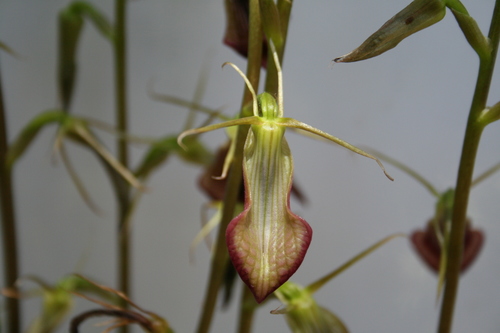
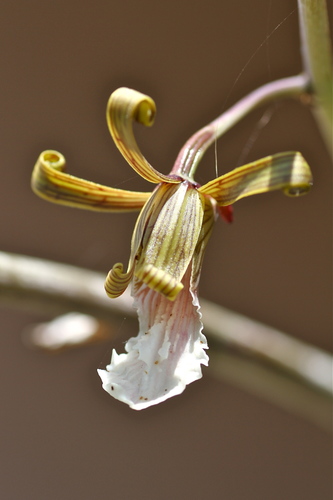
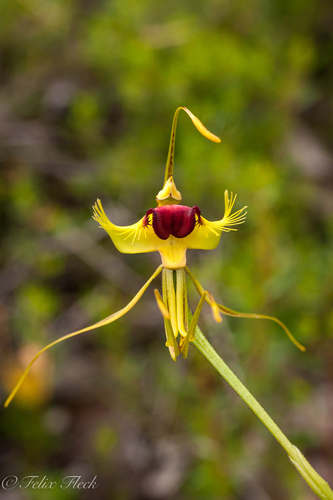
Caladenia lobata Fitzg., commonly called the butterfly orchid, has a single erect, hairy leaf that is 100–250 mm (4–10 in) long and 10–14 mm (0.4–0.6 in) wide. One or two greenish-yellow flowers marked with red are carried on a hairy spike that grows 300–500 mm (10–20 in) tall. Each flower is 80–100 mm (3–4 in) long and 70–90 mm (3–4 in) wide. The dorsal sepal is erect, 55–80 mm (2–3 in) long and 3–5 mm (0.1–0.2 in) wide. The lateral sepals are 55–80 mm (2–3 in) long and 6–8 mm (0.2–0.3 in) wide, curve upwards, sit closely parallel to each other, and end in narrow, club-like glandular tips. The petals are 50–60 mm (2.0–2.4 in) long and around 3 mm (0.1 in) wide, and spread horizontally or curve downwards. The labellum is 20–25 mm (0.8–1 in) long and 30–35 mm (1.2–1.4 in) wide. It is greenish-yellow with a red tip that curls downwards, and is delicately hinged so it vibrates in even the lightest breeze. The sides of the labellum spread widely or turn upwards, and bear many erect to spreading teeth up to 12 mm (0.5 in) long. There are six or eight rows of red calli clustered in the center of the labellum. Flowering occurs from late September to November. This orchid usually grows in dense, shrubby forest in well-drained grey sand, gravelly or clayey loam, or laterite. It often grows on flats and slopes near streams, and is found between Bunbury and the Stirling Range in the Esperance Plains, Jarrah Forest and Swan Coastal Plain biogeographical regions of Western Australia.