About Caladenia heberleana Hopper & A.P.Br.
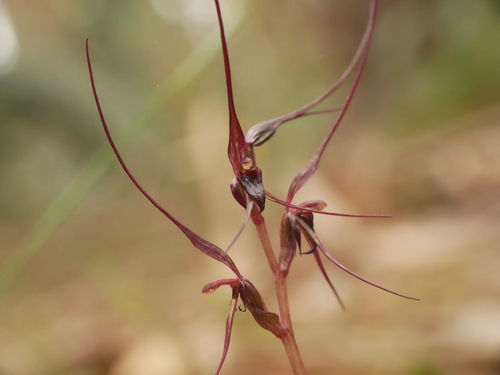
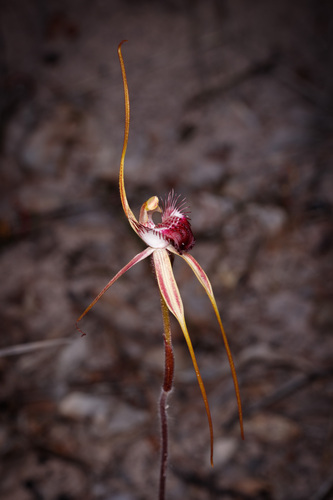
Caladenia heberleana is a terrestrial, perennial, deciduous herb that grows from an underground tuber. It produces a single erect, hairy leaf that measures 80–200 mm (3–8 in) long and 5–15 mm (0.2–0.6 in) wide. Between one and three flowers, each 80–120 mm (3–5 in) long and 60–120 mm (2–5 in) wide, are borne on a stalk that reaches 200–450 mm (8–20 in) tall. The flowers are colored red, white and pale yellow, with spreading lateral sepals and petals. All sepals and petals have thickened, club-like glandular tips. The lateral sepals and petals spread widely and point downwards below the horizontal plane. The erect dorsal sepal is 40–100 mm (2–4 in) long and about 3 mm (0.1 in) wide, while the lateral sepals are 40–100 mm (2–4 in) long and 3–6 mm (0.1–0.2 in) wide. The petals measure 40–85 mm (2–3 in) long and 2–4 mm (0.08–0.2 in) wide. The labellum is white, 17–26 mm (0.7–1 in) long and 10–15 mm (0.4–0.6 in) wide, with a curled-under maroon tip. The sides of the labellum have spreading teeth that grow up to 5 mm (0.2 in) long, and there are four rows of pale to deep red calli, up to 3 mm (0.1 in) long, along the center of the labellum. Flowering takes place from September to October.
Commonly known as Heberle's spider orchid, this species occurs between Augusta and Cape Arid in the Esperance Plains, Jarrah Forest and Mallee biogeographic regions of Western Australia. It most often grows in deep sandy soil in woodland. Its flowering is stimulated by summer fires, though flowering plants can also be found in areas that are swampy in winter, even when no earlier fire has occurred.