About Caladenia gracilis R.Br.
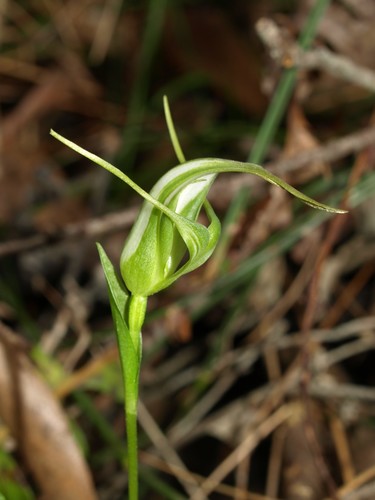
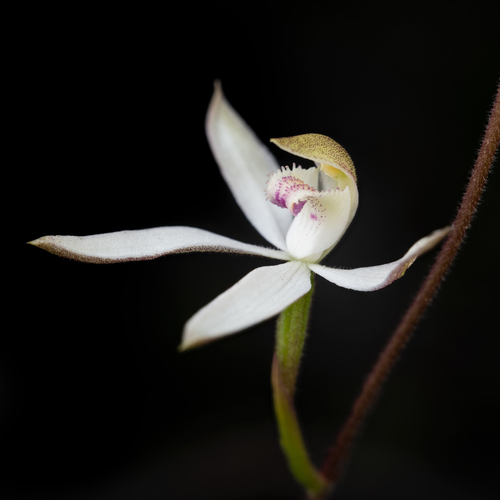
Caladenia gracilis R.Br. is a terrestrial, perennial, deciduous herb with an underground tuber, growing either singly or in small groups. It produces a single, slightly hairy leaf that is 60–300 mm (2–10 in) long and 1–6 mm (0.04–0.2 in) wide. Up to six musky or soapy-scented flowers grow on a 120–450 mm (5–20 in) tall spike. The front of the sepals and petals are white, sometimes tinged with pink or bronze, while the back of these structures are covered in greenish-brown or purplish glandular hairs. Sepals and petals spread horizontally or angle slightly downwards. The dorsal sepal is erect, linear in shape, 11–13 mm (0.4–0.5 in) long, and 3 mm (0.1 in) wide. It curves forward to form a hood over and around the sides of the column. The lateral sepals are 14–16 mm (0.55–0.63 in) long, about 3 mm (0.1 in) wide; petals are 12–14 mm (0.5–0.6 in) long and 3 mm (0.1 in) wide. The labellum is 5–6 mm (0.20–0.24 in) long, 4–5 mm (0.16–0.20 in) wide, and is white with red or purplish spots. Near the labellum's base, its edges are slightly wavy; closer to the tip, the edges bear teeth. The labellum's tip is strongly curled under and pink. Four rows of calli run along the centre of the labellum. The column has broad, rounded wings and reddish blotches. Flowering occurs in October and November, and after flowering it produces oval-shaped, greenish or reddish capsules. These capsules are 10–14 mm (0.4–0.6 in) long and 3–4 mm (0.1–0.2 in) wide. Commonly called musky caps, Caladenia gracilis grows in New South Wales, Victoria, Tasmania and South Australia. It inhabits open forest, dry ridges, and dry slopes. In New South Wales, it occurs south of the New England region. It is widespread across Victoria and Tasmania. In South Australia, it is found in the south east corner near Millicent, Glencoe and Wrattonbully.