About Caladenia fuscata (Rchb.f.) M.A.Clem. & D.L.Jones
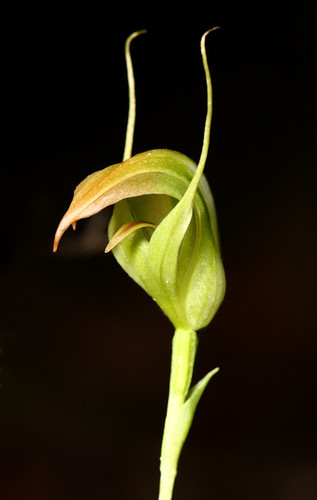
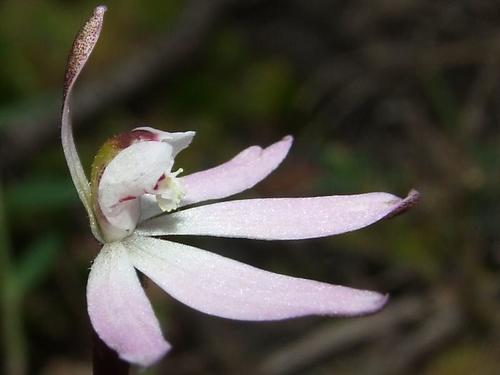
Caladenia fuscata is a terrestrial, perennial, deciduous herb that grows from an underground tuber. It produces a single, sparsely hairy, narrow linear leaf, which measures 5–18 cm (2–7 in) long and 2–3 mm (0.08–0.1 in) wide. A single white or pink flower is borne on a flowering spike that reaches up to 150 mm (6 in) in height. The dorsal sepal is erect and linear in shape, 7–12 mm (0.3–0.5 in) long, 1–2 mm (0.04–0.08 in) wide, and ends in a pointed tip. The lateral sepals and petals are usually 6–12 mm (0.2–0.5 in) long and about 2 mm (0.08 in) wide, with a dense band of short, reddish-brown glandular hairs covering their outer surfaces. The labellum is egg-shaped, about 6 mm (0.2 in) long and wide, white or pinkish, with three lobes and prominent red stripes. The mid-lobe is small and pointed, with small teeth along its edge and several rows of yellow-tipped calli in its centre. The lateral lobes are prominent, broad, and protrude past the mid-lobe. The column is 5–7 mm (0.2–0.3 in) long, curves inwards, and has narrow wings. Flowering occurs in September and October, after which a non-fleshy, dehiscent capsule develops that holds a large number of seeds. This species is similar to Caladenia carnea, but can be distinguished by its single flower, earlier flowering period, and red stripes on the labellum and column. This species, commonly called dusky fingers, is distributed across Queensland, New South Wales, Victoria, Tasmania, and South Australia. It grows in open forest, woodland, and coastal scrub across a range of soil types, and is mostly found only on the drier western side of the Great Dividing Range. It has also been recorded in New Zealand.