About Caladenia dimidia Hopper & A.P.Br.
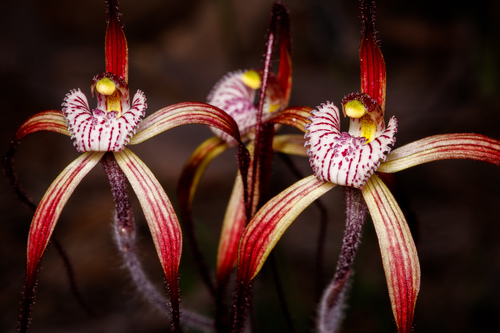
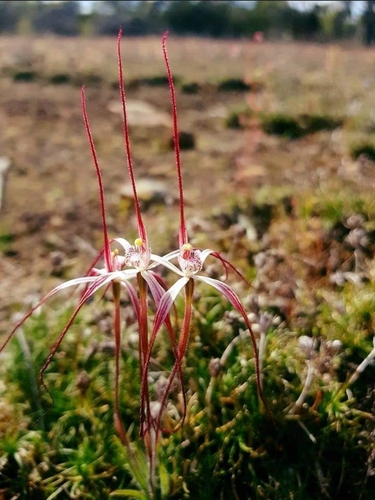
Caladenia dimidia Hopper & A.P.Br., commonly called the chameleon orchid, is a terrestrial, perennial, deciduous herb that grows from an underground tuber. It occurs either as a solitary individual or in small clumps. This species produces a single erect, linear, hairy leaf that is 7–15 cm (3–6 in) long and 2–3 mm (0.08–0.1 in) wide. The leaf is pale green, with purple-red blotches near its base. One or two yellow to cream-coloured, sometimes pinkish flowers with dark maroon markings grow on a stalk 15–30 cm (6–10 in) tall. The full flowers measure 7–11 cm (3–4 in) long and 4–9 cm (2–4 in) wide. The bases of the sepals and petals are linear to lance-shaped and held stiffly for roughly one third of their length, then suddenly narrow into a dark brown, densely glandular, thread-like section. The dorsal sepal is erect, linear to lance-shaped, 4.5–7 cm (2–3 in) long, 2–3 mm (0.08–0.1 in) wide at its base, with slightly inward-curving edges. The lateral sepals are spreading and downcurved, 5–7.5 cm (2–3 in) long and 2–3 mm (0.08–0.1 in) wide at the base, and angle downwards. The petals are 4.6–6.5 cm (2–3 in) long and 2–3 mm (0.08–0.1 in) wide at the base; they spread widely near the base, then angle downwards. The labellum is white or pale yellow with maroon stripes, spots, and blotches. It is comparatively small, diamond-shaped, 7–11 mm (0.3–0.4 in) long and 6–8 mm (0.2–0.3 in) wide, and curves downward at its front edge. The sides of the labellum curve upward and bear a fringe of small teeth that decrease in size toward the front of the labellum. There are 6 to 14 creamy-white or pale pink, narrow anvil-shaped calli arranged in two rows along the centre of the labellum, covering at least half of its length. Flowering occurs from July to late September. Caladenia dimidia is similar to Caladenia polychroma, but has smaller flowers overall, and a smaller labellum specifically. This species is a common orchid found in the eastern wheatbelt of Western Australia, ranging from near Paynes Find to near Ravensthorpe. It occurs within the Avon Wheatbelt, Coolgardie, Esperance Plains, Geraldton Sandplains, Jarrah Forest, and Mallee biogeographic regions, growing in a range of habitats that are generally wet during winter.