About Caladenia dilatata R.Br.
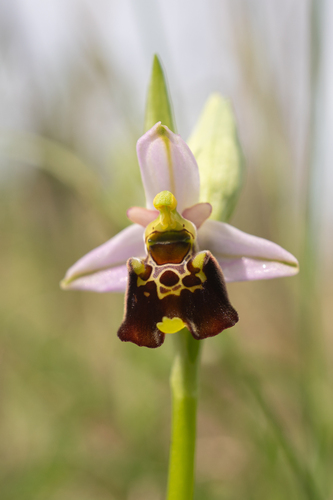
Caladenia dilatata R.Br. is a terrestrial, perennial, deciduous herb that grows from an underground tuber. It produces a single leaf 60–130 mm (2–5 in) long and 6–8 mm (0.2–0.3 in) wide, marked with red spots near its base; the leaf is often already dried by the time the plant flowers. One yellowish-green flower with reddish stripes grows on a 200–350 mm (8–10 in) tall flowering stem.
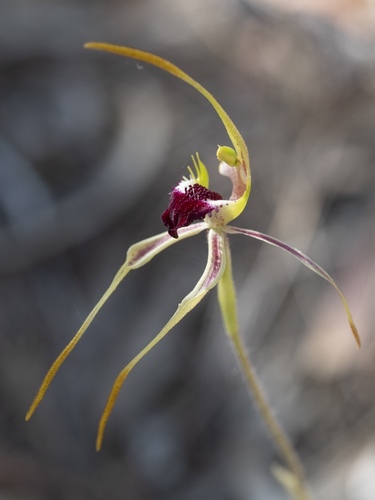
The sepals and petals have brown or yellowish, densely glandular, thread-like tips that are 5–15 mm (0.2–0.6 in) long. The erect dorsal sepal is 35–50 mm (1–2 in) long and 2–3.5 mm (0.08–0.1 in) wide, with a drooping tip. The lateral sepals are 35–50 mm (1–2 in) long, 3–3.5 mm (0.12–0.14 in) wide near their base, then taper to thread-like tips, and are held either parallel to each other or crossed. The petals are 25–35 mm (1–1 in) long, 1.5–2 mm (0.06–0.08 in) wide, and curve downwards. The labellum is 13–17 mm (0.5–0.7 in) both long and wide; it is green near its base, fading to white with a dark maroon tip. Four or five pairs of thin teeth 4–5 mm (0.2–0.2 in) long line the sides of the labellum, and four densely crowded rows of calli up to 1.5 mm (0.06 in) long sit in the centre of the labellum. Flowering occurs from November to January.
Commonly called the green-comb spider-orchid, this species occurs in Victoria, south-eastern South Australia, and Tasmania. It grows in coastal or near-coastal heath, and in open forest in areas further inland.
After pollination, the orchid’s flower closes to form a papery capsule. The capsule produces yellow, brown, or black dust-sized seeds, then dries and splits open when mature to release millions of seeds that are dispersed by wind or water. Seeds can only germinate after infection by a mycorrhizal fungus, so very few seeds grow into mature plants.
The elongated tips of the flower produce sexual attractants that draw pollinators via pseudocopulation, where pollinators mistake the flower for a female wasp. Thynnid wasps are commonly attracted to the flower this way. Caladenia dilatata has a mutualistic relationship with its mycorrhizal fungi: the fungus gains some nutrition from the orchid, and the orchid requires the fungus to germinate. The full extent of the orchid’s dependence on the fungus is not currently well understood. While the species’ fire ecology is also not well understood, it is thought that forest fires clear surrounding vegetation, increasing light levels and ground-level temperature. Fewer competing plants are also believed to lead to increased moisture levels that benefit Caladenia dilatata.
The Kulin people know this species as koolin, and its tubers are eaten either raw or baked.