About Caladenia denticulata Lindl.
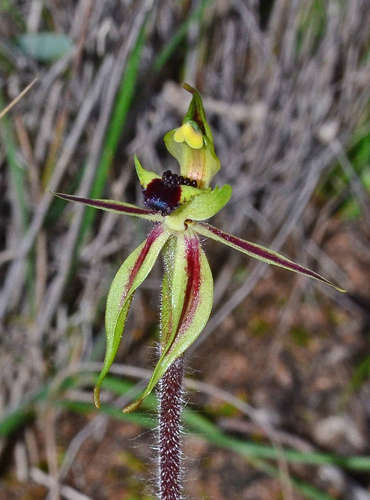
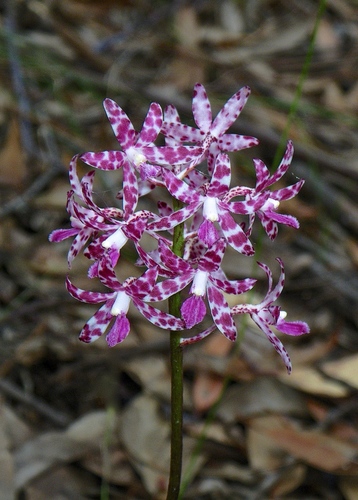
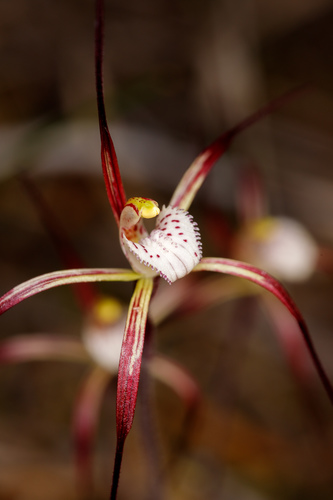
Caladenia denticulata subsp. denticulata, commonly called the yellow spider orchid, is a terrestrial, perennial, deciduous herb that grows from an underground tuber. It produces a single erect, hairy leaf that is 6 to 18 centimetres (2 to 7 inches) long and 2 to 4 millimetres (0.08 to 0.2 inches) wide. One or two flowers are borne on a stem that reaches 15 to 35 centimetres (6 to 14 inches) in height; each individual flower is 7 to 10 centimetres (3 to 4 inches) long and 5 to 9 centimetres (2 to 4 inches) wide. The dorsal sepal is erect, measuring 4 to 7 centimetres (2 to 3 inches) long and 1.5 to 3 millimetres (0.06 to 0.1 inches) wide at its base. It is linear to lance-shaped, pale to greenish-yellow, and ends in a drooping, dark brown, thread-like glandular tip. The arching lateral sepals and petals share a similar size, shape, and color with the dorsal sepal, though the petals are slightly narrower and shorter. The labellum is white with pale red markings, curves forward, and has white to pale red teeth along its margins; these teeth decrease in size toward the labellum's tip. Up to 13 pairs of anvil-shaped, cream-coloured calli are arranged in two rows along roughly half the length of the labellum, also decreasing in size toward the tip. Flowering occurs between August and early October. This orchid is found in the south-west corner of Western Australia, between Waroona and Eneabba, in the Avon Wheatbelt, Geraldton Sandplains, Jarrah Forest, and Swan Coastal Plain biogeographic regions. It grows in wandoo and York gum woodland.