About Caladenia decora Hopper & A.P.Br.
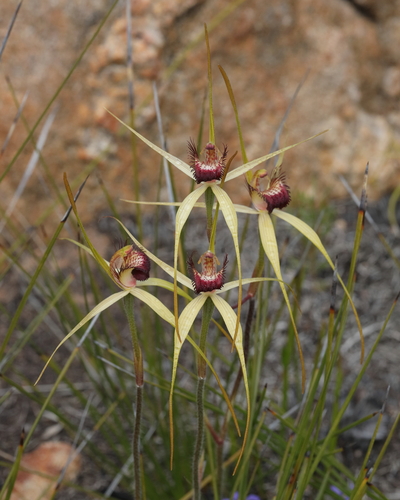
Caladenia decora Hopper & A.P.Br. is a terrestrial, perennial, deciduous herb that grows from an underground tuber, occurring either as a solitary plant or in small clumps. It produces a single erect, linear, hairy leaf that measures 9–22 cm (4–9 in) long and 6–10 mm (0.2–0.4 in) wide. The leaf is pale green, with purple-red blotches near its base. Up to three red, yellow, and green flowers grow on a stalk that stands 25–50 cm (10–20 in) tall. Each flower is 6–15 mm (0.2–0.6 in) long and 5–10 mm (0.2–0.4 in) wide, placing this species among the largest of Western Australian spider orchids. The bases of the sepals and petals are linear to lance-shaped, held stiffly for roughly one-third of their length, then narrow suddenly. The dorsal sepal is erect and linear to lance-shaped, 4.5–7 cm (2–3 in) long and 3–6 mm (0.1–0.2 in) wide at its base, with a yellow-brown glandular tip that can be up to 25 mm (1 in) long. The lateral sepals spread outward and curve downward, 5–8 cm (2–3 in) long and 3.5–8 mm (0.1–0.3 in) wide at the base, with a tip that matches the dorsal sepal's tip. The petals are 4–6 cm (2–2 in) long and 3.5–5 mm (0.1–0.2 in) wide at the base; they angle slightly upward before curving gently downward, and sometimes do not have glandular tips. The labellum is dark pink with red stripes and ends in a dark tip. It is linear to heart-shaped, 20–28 mm (0.8–1 in) long and 13–20 mm (0.5–0.8 in) wide, and curves downward at its front edge. The sides of the labellum curve upward and bear a fringe of narrow teeth up to 9 mm (0.4 in) long; the teeth decrease in length suddenly about halfway along the labellum toward its tip. There are four rows of pale maroon, golf stick-shaped calli in the center of the labellum that extend over at least three-quarters of the labellum's length, decreasing in size toward the tip. Flowering occurs from mid-August to October. This species is similar in size to Caladenia pectinata, but has brighter coloring, often has gland-tipped petals, and has a more easterly distribution. Hybrids between Caladenia decora and Caladenia longicauda subsp. crassa are common. Commonly called the Esperance king spider orchid, this species is found near the coast between Bremer Bay and Cape Arid, within the Esperance Plains and Mallee biogeographic regions of Western Australia. It most often grows in shrubland and woodland in winter-wet areas, and can sometimes also be found growing near granite outcrops.