About Caladenia cucullata Fitzg.
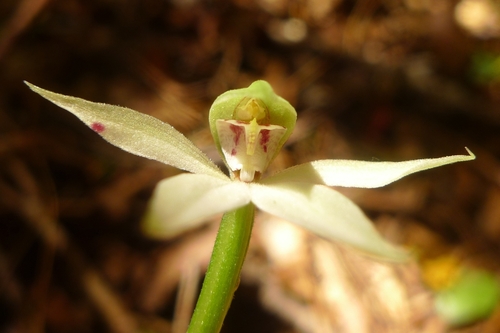
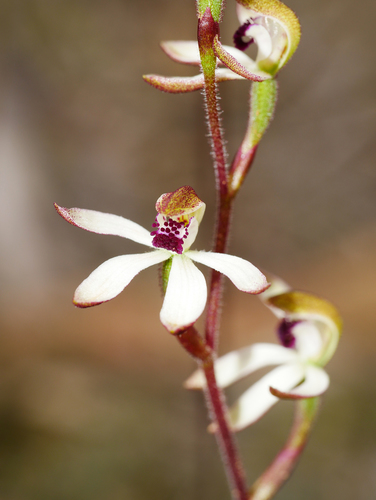
Caladenia cucullata Fitzg. is a terrestrial, perennial, deciduous herb that grows from an underground tuber. It produces a single, sparsely hairy linear leaf that is 6–20 cm (2–8 in) long and 1–6 mm (0.04–0.2 in) wide. Between one and seven white flowers, each 10–35 mm (0.4–1 in) across, are borne on a flowering spike that stands 10–35 cm (4–10 in) tall. The lateral sepals and petals are 8–13 mm (0.3–0.5 in) long and 3–4 mm (0.1–0.2 in) wide, shaped narrow elliptic to egg-shaped, and spread horizontally. Their outer surface is covered in greenish to brownish glands, while the inner surface is white and glabrous; petals are shorter and narrower than the sepals. The dorsal sepal is broadly egg-shaped, it is erect near its base and bends roughly 90 degrees near the middle to form a hood over the column. The labellum is roughly egg-shaped, measuring 5–7 mm (0.2–0.3 in) long and about 4 mm (0.2 in) wide when flattened, and it has three lobes. It is white with reddish-purple markings and a dark purple, pointed tip. The sides of the labellum are wavy and more or less erect, and the tip curves strongly downwards. There are four regular rows of thick, club-shaped calli that decrease in size toward the tip of the labellum. The column is bent forwards, has wavy wings and red spots. Flowering of this species takes place from September to November. Hooded caladenia (the common name of this species) grows in forests, most commonly in poor sandy or stony soil. In New South Wales, it occurs on the tablelands and western slopes south of Dubbo. In Victoria, it is widespread, particularly in the goldfields region. In South Australia, it is uncommon, and has only ever been found in the far south-eastern corner, within a short distance of the Victorian border.