About Caladenia colorata D.L.Jones
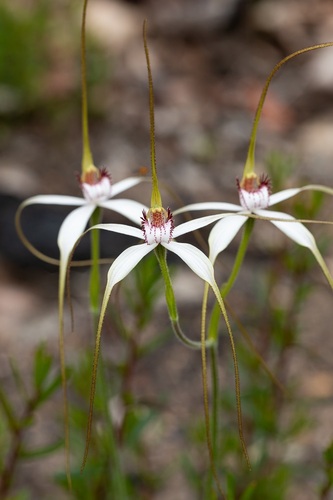
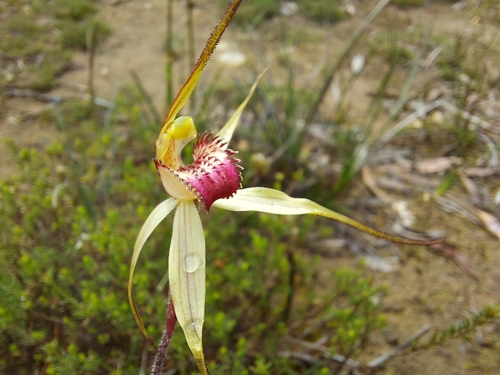
Caladenia colorata is a terrestrial, perennial, deciduous herb that grows from an underground tuber. It produces a single erect, densely felted dark green leaf that is linear to elliptic in shape, measuring 4–10 cm (2–4 in) long and 6–9 mm (0.2–0.4 in) wide, with a red base. One or more flowers are borne on a stalk 5–30 cm (2–10 in) tall. Flowers are typically around 5 cm (2 in) across, most often creamy-green with maroon, pink, mauve, blood-red or purple-brown markings. Flower colour is highly variable, and individuals may be entirely purplish-brown. The tips of the petals and sepals are blackish from gland presence, and flowers sometimes carry a faint petrochemical or musky fragrance. The dorsal sepal is 33–40 mm (1–2 in) long and about 2 mm (0.08 in) wide; it is linear near the base, and tapers into a thread-like tail covered in many brown to blackish glands. The lateral sepals are 33–40 mm (1–2 in) long and about 4 mm (0.2 in) wide; they are linear to lance-shaped near the base, and narrow to a thread-like gland-covered tail around their middle. Petals have a similar structure to the sepals, but are slightly shorter and narrower at the base. The labellum is egg-shaped when flattened, with an elongated curled-under tip, measuring 10–14 mm (0.4–0.6 in) long and 7–8 mm (0.28–0.31 in) wide. Reddish teeth up to 1.5 mm (0.06 in) long line the edges of the labellum, and four or six rows of dark reddish-purple, foot-shaped calli run along the labellum’s centre. Flowering occurs between August and September. This orchid usually grows in woodland. In South Australia, it occurs in the Mount Lofty Ranges, the Murray–Darling basin, and the south-east of the state. In Victoria, it has been recorded between the Glenelg River and Little Desert National Park in the far west of the state, though these plants are only tentatively assigned to this species, pending further research.