About Caladenia chlorostyla D.L.Jones, Molloy & M.A.Clem.
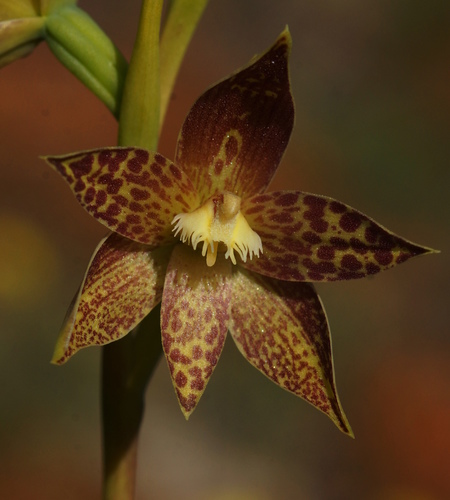
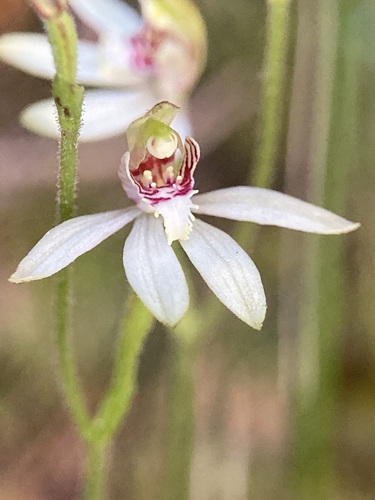
Caladenia chlorostyla D.L.Jones, Molloy & M.A.Clem. is a terrestrial, perennial, deciduous herb that usually grows as a solitary individual. It has an underground tuber, and a single, sparsely hairy, bright green, narrow linear leaf that reaches up to 5–15 cm (2–6 in) long and 1–3 mm (0.04–0.1 in) wide. One, or sometimes up to five, unscented flowers up to 11–16 mm (0.4–0.6 in) in diameter are borne on a thin, wiry spike that is 1–30 cm (0.4–10 in) tall. The sepals and petals are white, pale mauve or pinkish with greenish-white tips. The dorsal sepal stands erect with its sides curved forwards; the lateral sepals are held flat and horizontally, and the petals either spread widely or turn inwards. The dorsal sepal is 6–11 mm (0.2–0.4 in) long and narrow egg-shaped, while the lateral sepals and petals are 6–8 mm (0.2–0.3 in) long, about 2 mm (0.08 in) wide, sickle-curved, and egg-shaped with the narrower end at the base. The column is green with transverse red bars. Flowering occurs between September and January, and from December to April, it produces a fruit that is a green, oval-shaped capsule 10–12 mm (0.4–0.5 in) long, sometimes marked with purple stripes. This caladenia grows in sunny locations in scrub, and also occurs in old-growth forests and frequently grows in mature pine plantations. In New Zealand, C. saccata is recognized as a synonym of C. chlorostyla.