About Caladenia brunonis (Endl.) Rchb.f.
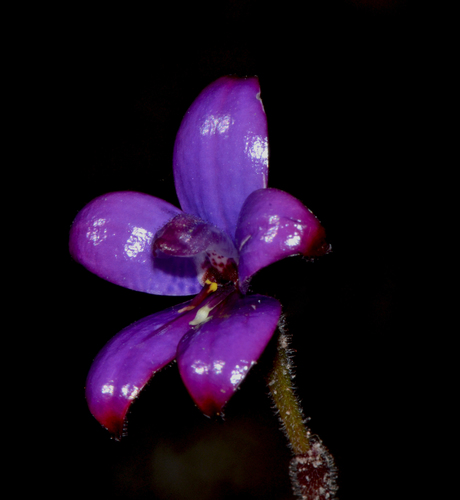
Caladenia brunonis, also referred to as Elythranthera brunonis, is a terrestrial, perennial, deciduous, sympodial herb. It grows from a tuber that is partly surrounded by a fibrous, multi-layered protective sheath, and has a few inconspicuous fine roots. This species produces a single flattened, dark green, hairy leaf. The leaf is 20–80 mm (0.8–3 in) long, about 7 mm (0.3 in) wide, and has a reddish-purple underside. Up to three glossy purple flowers grow on a 150–300 mm (6–10 in) tall spike. Each flower is 20–30 mm (0.8–1 in) long and 10–30 mm (0.4–1 in) wide. The sepals and petals spread apart from one another, have blackish tips, and are blotched with red or purple on their outer surfaces. The erect dorsal sepal is 16–20 mm (0.6–0.8 in) long and 6–8 mm (0.2–0.3 in) wide. The lateral sepals and petals are 14–18 mm (0.6–0.7 in) long and 6–8 mm (0.2–0.3 in) wide. The labellum is whitish, about 5 mm (0.2 in) long and 0.5 mm (0.02 in) wide, with an upward-curving tip. At the base of the labellum, there are two erect, fleshy calli about 4 mm (0.2 in) high that have yellow bases and black or dark purple tips. Flowering occurs from August to early November. This is a common, widespread species in Western Australia, ranging north to Kalbarri and east to Israelite Bay. It grows in forest, woodland, and heath habitats.