About Caladenia brumalis D.L.Jones
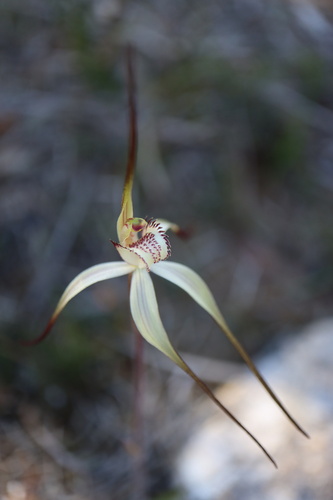
Caladenia brumalis is a terrestrial, perennial, deciduous herb that grows from an underground tuber. It produces a single erect, hairy, lance-shaped leaf that is 4–8 cm (2–3 in) long and 9–11 mm (0.35–0.43 in) wide. Usually only one flower is borne on a stem 12–20 cm (5–8 in) high. The flower is white to pinkish with darker stripes and measures about 7 cm (3 in) across. The dorsal sepal is lance-shaped near its base, 5–7.5 cm (2–3 in) long and 3–4 mm (0.1–0.2 in) wide at the base, tapering to a thread-like tip covered in numerous black glands. The lateral sepals are linear to lance-shaped, 5–6.5 cm (2–3 in) long and 3.5–6.5 mm (0.1–0.3 in) wide, tapering to a tip that matches the dorsal sepal's tip in structure. The petals resemble the lateral sepals but are slightly shorter and narrower. The labellum is whitish or pinkish, sometimes marked with red, and measures 14–16 mm (0.55–0.63 in) long and 8–10 mm (0.3–0.4 in) wide, with erect lateral lobes. There are seven to nine calli, each around 2 mm (0.08 in) long, on the sides of the lobes, and many short, white-tipped calli along the centre of the labellum. Flowering takes place in August and September. This species of caladenia grows in woodland, mallee, shrubland and sedgeland, restricted to coastal locations near Adelaide, and on the Eyre and Yorke Peninsulas. It is documented to flower very abundantly after fire.