About Caladenia atradenia D.L.Jones, Molloy & M.A.Clem.
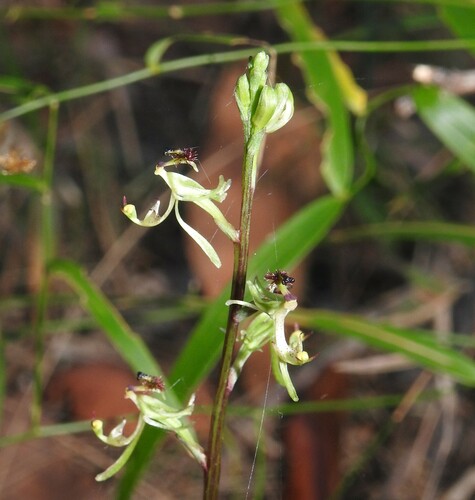
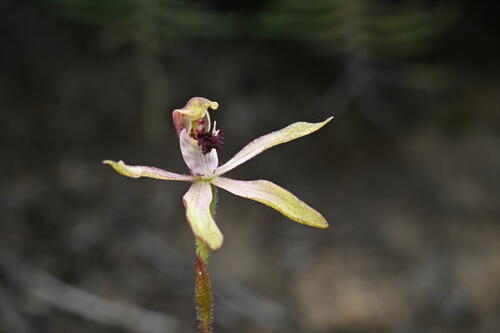
Caladenia atradenia D.L.Jones, Molloy & M.A.Clem. is a terrestrial, perennial, deciduous herb. It may grow alone or in groups of up to ten individual plants. This species has an underground tuber and a single, hairy, narrow linear leaf that is 10–16 cm (4–6 in) long, 1–3 mm (0.04–0.1 in) wide, and colored dark to reddish green. One or sometimes two flowers, each 20 mm (0.8 in) in diameter, are borne on a thin, hairy, reddish-green, wiry spike that grows 10–30 cm (4–10 in) high. The flowers are dark to reddish-green, often marked with dark magenta. The dorsal sepal curves forward to form a hood over the column. It is 7–10 mm (0.3–0.4 in) long, 2–3 mm (0.08–0.1 in) wide, and has a narrow egg shape with a pointed tip. The lateral sepals are 7–11 mm (0.3–0.4 in) long, 2–3 mm (0.08–0.1 in) wide, lance-shaped and curved. The petals are 7–10 mm (0.3–0.4 in) long, about 2 mm (0.08 in) wide, and sickle-shaped. The labellum is white with purple bars, 5–6 mm (0.20–0.24 in) long, about 4 mm (0.16 in) wide when flattened. It has three lobes and curves forward. The lateral lobes of the labellum are about 1.5 mm (0.06 in) wide and erect. Between four and eight pairs of dark, purplish linear calli, decreasing in size toward the front, run along the sides of the labellum, and there are two rows of white-stalked, dark-headed calli on the mid-lobe. The column is 5–6 mm (0.20–0.24 in) long, erect, greenish with red markings, and has narrow wings. Flowering occurs between August and December. After flowering, a hairy capsule develops: it is 18–24 mm (0.7–0.9 in) long, 5–6 mm (0.20–0.24 in) wide, and green with red stripes. Commonly called bronze fingers, this orchid grows in poor soils, most often in thick leaf litter under shrubs in mixed conifer/broadleaved-hardwood forest, but it also occurs on bare ground and in exotic pine plantations. It is found on both the North and South Islands of New Zealand.