About Caladenia aperta (Hopper & A.P.Br.) M.A.Clem.
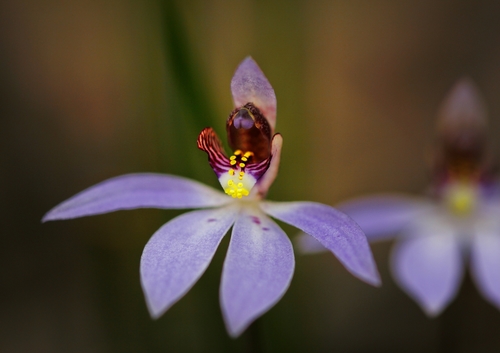
This orchid species is currently classified with the scientific name Caladenia aperta (Hopper & A.P.Br.) M.A.Clem., and was previously formally described under the name Cyanicula aperta. It is a terrestrial, perennial, deciduous herb that grows from an underground tuber. It produces a single hairy leaf, which measures 30 to 50 mm (1 to 2 inches) long and 4 mm (0.2 inches) wide. Usually, only one bluish-mauve flower grows on a stalk that is 50 to 150 mm (2 to 6 inches) tall, and the flower itself is around 20 mm (0.8 inches) long and wide. Rarely, individual plants produce white flowers, and the outer surface of bluish flowers is a lighter shade than the inner surface. The dorsal sepal is held erect, and measures 11 to 16 mm (0.4 to 0.6 inches) long and 2 to 3 mm (0.08 to 0.1 inches) wide. The lateral sepals and petals are similar in size to the dorsal sepal, though the lateral sepals are slightly wider. The labellum is 6 to 9 mm (0.2 to 0.4 inches) long and wide, and is reddish-mauve marked with darker bars. The sides of the labellum curve upwards but do not surround the column. The labellum has a down-curved white and yellow tip, and two rows of stalked yellow calli run along its mid-line. Flowering takes place from August to early October. This species, commonly known as the western tiny blue china orchid, is distributed near the south coast of Western Australia, ranging from Cape Arid National Park to Dumbleyung. It occurs within the Avon Wheatbelt, Coolgardie, Esperance Plains and Mallee bioregions of south-western Western Australia, and grows in heath, shrubland, or on granite outcrops.