About Caladenia alpina R.S.Rogers
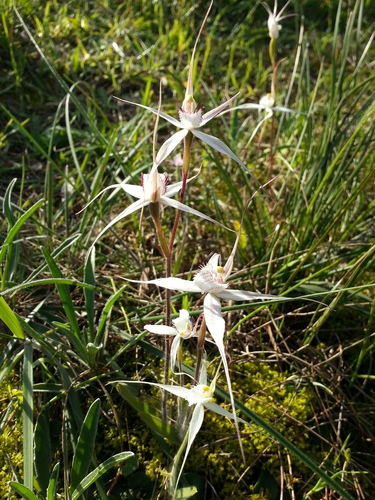
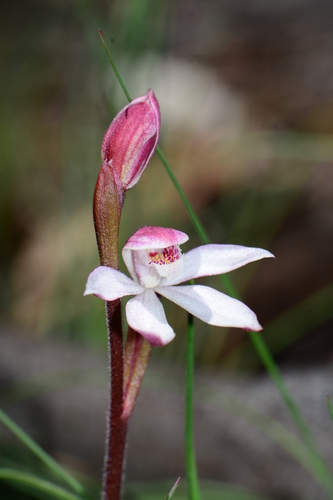
Caladenia alpina is a terrestrial, perennial, deciduous herb with an underground tuber. It produces a single, sparsely hairy, lance-shaped leaf that is 9–28 cm (4–10 in) long and 5–8 mm (0.2–0.3 in) wide. The leaf is thick, fleshy, and ranges in color from green to dark reddish-green. One to three flowers, most commonly two, are carried on a spike that reaches up to 30 cm (10 in) in height, and each flower is around 40 mm (2 in) in diameter. The dorsal sepal is broadly egg-shaped, 4–8 mm (0.2–0.3 in) wide, and curves forward to form a hood over the flower's column. The petals and lateral sepals are broad, 12–20 mm (0.5–0.8 in) long; they are white and glabrous on the front, and pinkish red to maroon with glandular hairs on the back. The labellum is approximately 9 mm (0.4 in) long when flattened. It is white with dark red to purple spots and lines, has a wavy margin, a few short teeth, and a pointed tip. There are four evenly spaced rows of calli on the surface of the labellum. These calli are club-shaped, yellow or whitish, and become darker and shorter toward the tip of the labellum. The column is about 7 mm (0.3 in) long, has broad wings, and bears red spots or streaks. In its distribution and habitat, mountain caladenia most often grows in subalpine zones above 1,000 m (3,000 ft), in forest, snow gum woodland, herbfields, or near ponds and bogs. In New South Wales, it occurs on the Southern Tablelands south of the Brindabella Range. In Victoria, it is found on the Great Dividing Range and in the Grampians. In New Zealand, Caladenia lyallii occurs on the North Island, South Island, and Stewart Island.