About Cakile maritima Scop.
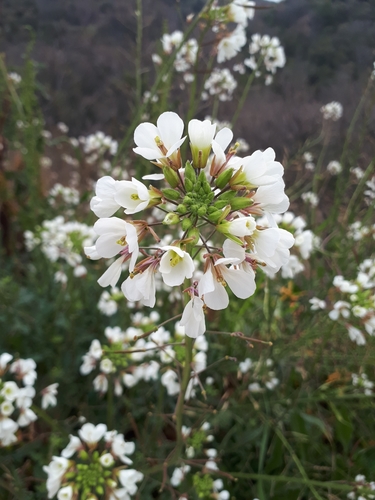
Cakile maritima Scop. is a glabrous, succulent annual plant with a slender or stout taproot. It has a branched prostrate or ascending stem that reaches 15–45 cm (5.9–17.7 in) in length. Its fleshy, lobed leaves grow alternately along the stem, with different shapes at different stem positions: lower leaves are obovate or oblanceolate, while upper leaves are oblong. In the United Kingdom, this species blooms between June and August. Its small flowers come in white, lilac, or purple shades, with four petals and an overall width of up to 25 mm (0.98 in). After flowering, it produces short, stubby seed capsules that are green when young and turn brown as they mature. Each capsule holds two smooth, yellow or brown seeds. The seed oil of this plant contains a high level of erucic acid.
Cakile maritima is native to temperate regions of North Africa, western Asia, and Europe. Within its native range, it is found in Algeria, the Canary Islands, Egypt, Libya, the Madeira Islands, Morocco, and Tunisia in Africa; the Caucasus, Georgia, Iran, Israel, Syria, and Turkey in Western Asia; Estonia and Ukraine in Eastern Europe; Belgium, Germany, the Netherlands, and Poland in middle Europe; Denmark, Finland, Iceland, Norway, Sweden, and the United Kingdom in Northern Europe; Albania, Bulgaria, Croatia, Greece, Italy, Montenegro, Romania, Serbia, and Slovenia in South-eastern Europe; and France, Portugal, and Spain in Southwestern Europe. It is also widely naturalized outside its native range in North America. It grows on foreshores near large dune systems and in shingle banks, and it is tolerant of salt spray and transient seawater inundation. It is pollinated by a wide range of insects including Apis mellifera, Eristalis intricarius, and Pieris rapae.
Its leaves are edible, and are preferably cooked and not eaten in large quantities. Its seed oil can be used for industrial applications.