About Caesia calliantha R.J.F.Hend.
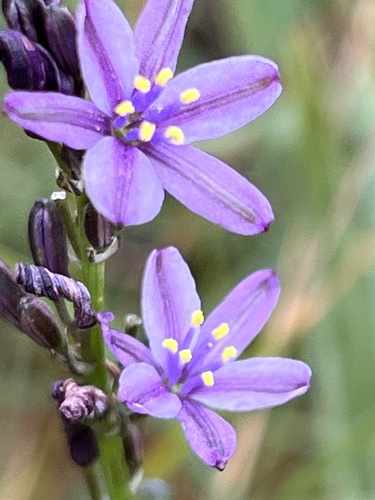
Caesia calliantha R.J.F.Hend. is a tufted perennial plant in the family Asphodelaceae. It has fibrous roots paired with broad spindle-shaped tubers. Its leaves grow in crowded, grass-like tufts at the base of the plant; they are long and narrow, reaching up to 30 cm (12 in) in length and 9–15 mm (0.35–0.59 in) in width. The inflorescence develops from a tall, erect stem that can grow up to 50 cm (20 in) long, emerging from the center of the basal leaf tuft. Flowers are arranged in a raceme at the top of the stem, with the youngest flowers positioned at the apex of the raceme. Flowers grow in clusters of 1 to 3, and range in color from striking lilac blue to deep blue-purple. They form a star shape made of 6 petals that measure 6–9 mm (0.24–0.35 in) long, and the petals become spirally twisted after flowering. The flower anthers are supported by 6 narrow tubular stalks that are all the same length. The fruit produced by Caesia calliantha is a small, rounded capsule that is 5–7 mm (0.20–0.28 in) in diameter and holds several seeds. Capsules start yellow-green and turn brown when mature, then split along their seams to release the seeds. Caesia calliantha is most commonly found in Victoria, New South Wales, South Australia, and Tasmania. It occurs primarily in grassy woodland vegetation; in Tasmania, it is distributed across the state's midlands. It can also grow successfully in a variety of other ecological settings, including heathlands and open forests, and can be found growing from sea level up to sub-alpine altitudes. This species typically prefers moist soils, and grows in areas ranging from full sun to semi-shade.