About Caerostris sexcuspidata (Fabricius, 1793)
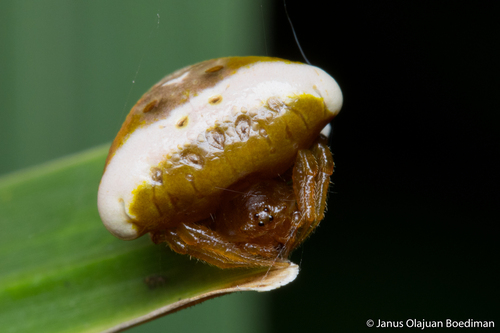
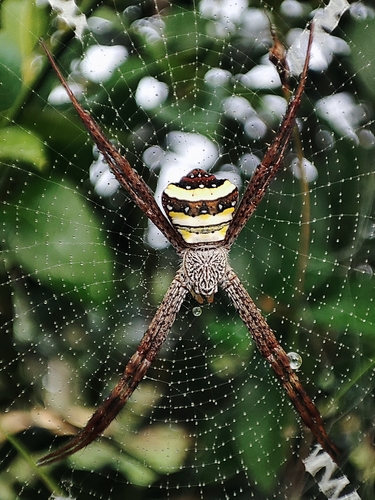
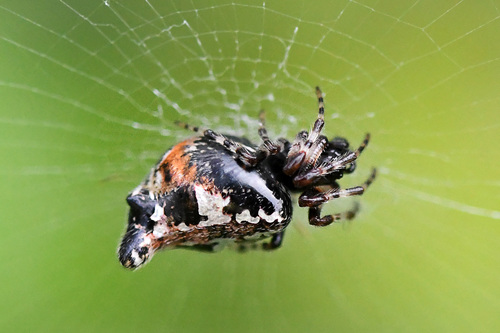
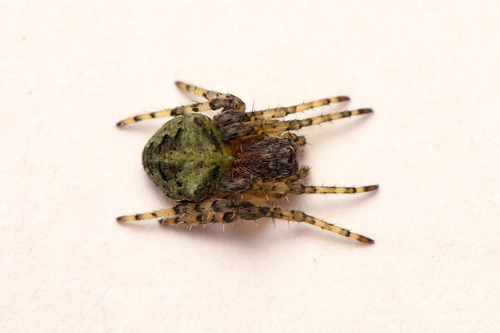
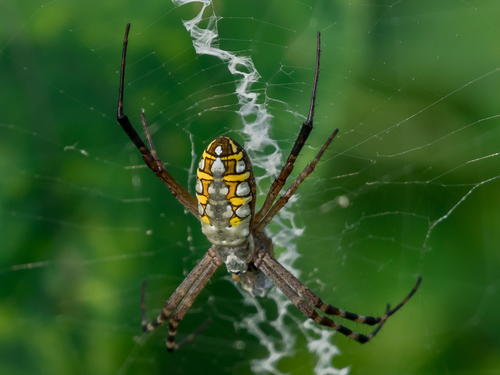
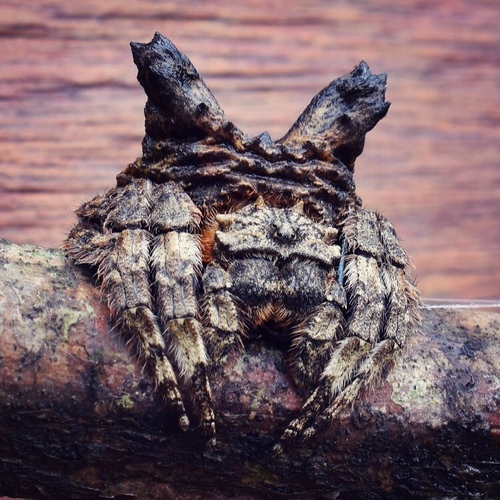
All Caerostris species are greyish brown, with horny or leathery protuberances on their carapace and abdomen that give them a bark-like appearance. On the upper cephalic region of the carapace, there is a transverse row of four conical protuberances. The abdomen is round to oval, and its dorsal surface varies in shape. The legs have rows of long setae, and they fit closely against the body when the spider is resting. The dorsal surface is cryptically colored and bears horny projections that help with camouflage. From above, the legs are drably colored, but they are clearly zebra-striped when viewed from underneath. Caerostris sexcuspidata, commonly called the common bark spider, is the most widespread of the bark spiders found in Southern Africa, and it shows considerable variation in abdomen shape. Its abdomen protrudes over the carapace, and its eight small eyes sit on a tubercle at the front of the carapace. Caerostris sexcuspidata occurs across Africa from Cameroon to Ethiopia, and extends south to South Africa; it is also found in the Seychelles, Comoros, and Madagascar. In South Africa, the species has been recorded in all nine provinces, at elevations ranging from 1 to 2,785 meters above sea level. This species builds large orb webs, usually placed between trees. It is mainly a nocturnal species, and rests on tree bark during the day, where its brown coloration provides effective camouflage. During daylight, the spiders dismantle their web and retreat to a nearby branch, tucking their fine-haired legs against the body to blend in with their surroundings, resembling part of a branch complete with growth bulges. Although primarily nocturnal, these spiders may stay on their webs in shady, forested areas during the day. The species has been collected from a variety of crop environments, including apple, citrus, pine plantations, and tomatoes. A study conducted in Richards Bay, KwaZulu-Natal, found that C. sexcuspidata was the most abundant Araneidae species in rehabilitating dune forests, with 333 specimens collected, and webs were particularly abundant in 2-year and 8-year old stands.