About Cabera pusaria (Linnaeus, 1758)
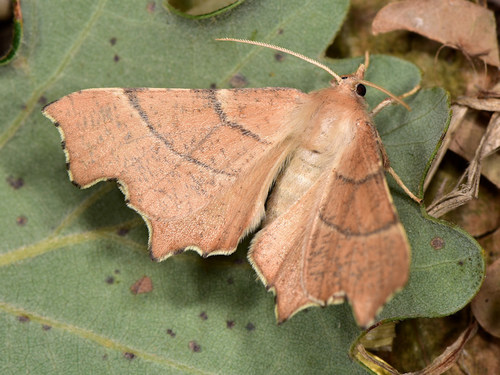
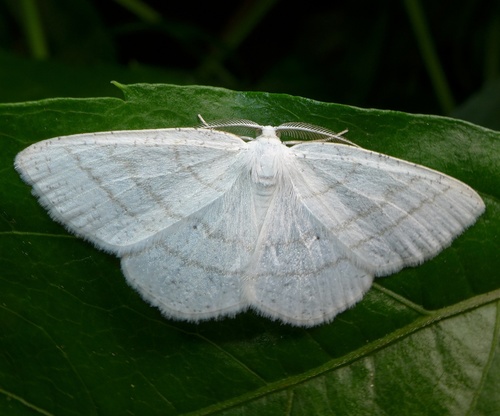
This moth species, Cabera pusaria, has white wings that are sometimes tinged with pink and lightly dusted with grey. The forewing has one fine curved grey fascia, and the hindwing has two fine grey fasciae. There are several described abnormal forms and a hybrid: the rare form ab. heveraria H.-Schiff. has dense grey dusting that covers almost the entire surface of the wings; ab. rotundaria Haw. is a rounder-winged form with the first lines very close together, and is reported to result from underfeeding larvae; the hybrid fletcheri Tutt (from a cross between a male C. pusaria and a female C. exanthemata) is intermediate between its two parent species, with fairly pure white wings and lines tinged with ochreous. The wingspan of Cabera pusaria ranges from 32 to 35 mm. The species produces one or two generations per year, and adults can be seen between May and August. This moth is active at night and is attracted to light. The larvae are elongated with a somewhat flattened head, and vary greatly in coloration: they may be green with vague purplish brown or blackish dorsal spots, purplish-brown with white spots, grey mixed with reddish, or occasionally yellowish. Larvae feed on a variety of trees and shrubs, including alder, aspen, birch, oak, rowan, and willow. The species overwinters in the pupal stage. The pupa is compact and brown, with olive-green wings.