About Cabera exanthemata (Scopoli, 1763)
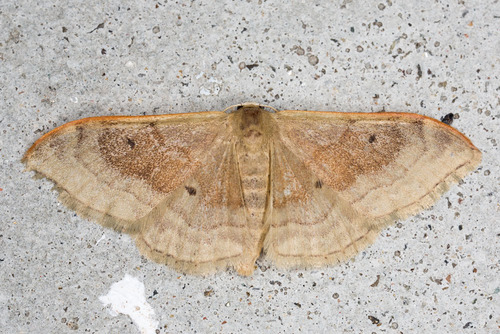
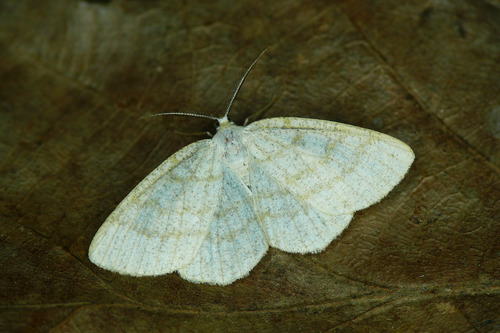
The common wave, Cabera exanthemata, is a moth in the family Geometridae. This species was first formally described by Giovanni Antonio Scopoli in his 1763 work Entomologia Carniolica, and it is found across the entire Palearctic region and the Near East. The wings of this moth are white, covered heavily with small yellowish dots that give the wings an overall buffish appearance. Narrow brown fasciae mark the wings: there are three fasciae on the forewing, and two on the hindwing. The aberration arenosaria Haw. (also called nogentina Th.-Mieg) is darker, more heavily dusted, and its markings are sometimes barely or not at all distinguishable. The aberration approximaria Haw. has its first two lines positioned very close together, almost merging. The aberration pellagraria Guen. is reported to be larger, with a more elongated forewing apex; it is whiter in color, less densely speckled, has less wavy lines, and bears a black discal dot on both wings. This form has been recorded in Lyons. The aberration unicolorata Teich is almost uniformly white, and is noted as a common form in Livonia. The wingspan of Cabera exanthemata ranges from 30 to 35 mm. The egg is oval-shaped and green, with fine net-like surface patterning. The larva varies greatly in color, being either green or brown; it usually has dark markings along its back, and sometimes has small white dots. This species produces either one or two generations per year, and adults can be observed any time between May and August. Cabera exanthemata adults fly at night and are attracted to light. In the British Isles, larvae of this species are green with yellow rings and black and purple spots, and feed on the leaves of alder, aspen, beech, birch and willow. This species overwinters in the pupal stage.