About Butyriboletus subappendiculatus (Dermek, Lazebn. & J.Veselský) D.Arora & J.L.Frank
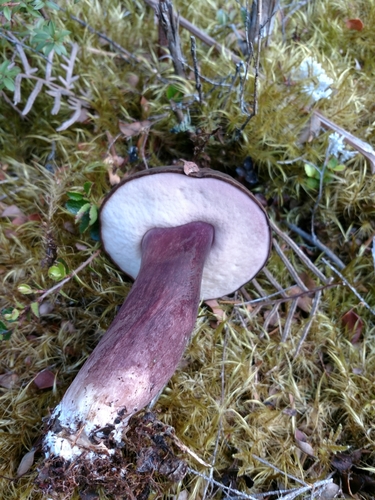
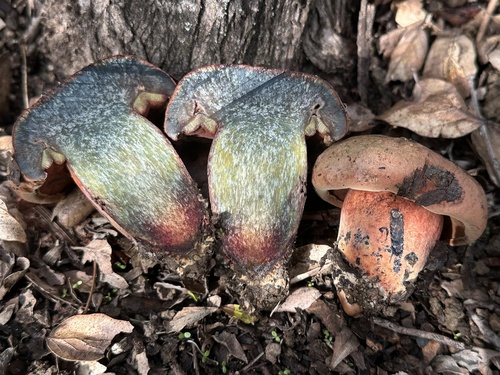
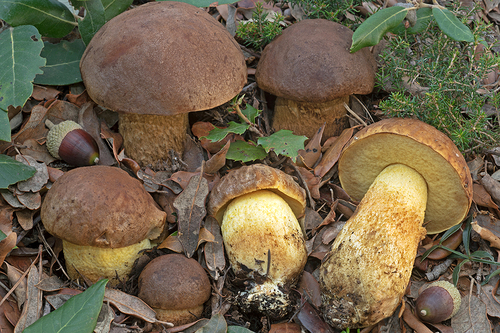
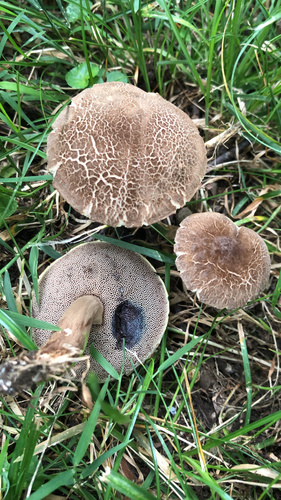
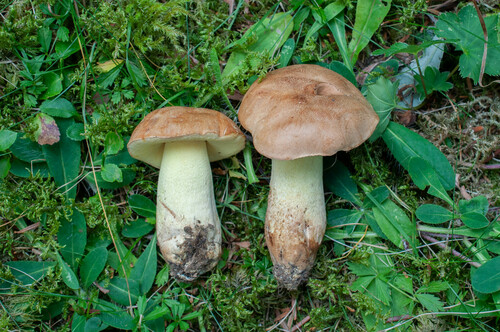
Butyriboletus subappendiculatus produces medium-sized fruiting bodies (basidiocarps) with a cap (pileus) that can reach up to 8 cm across. Young caps are hemispherical, and become convex to flat-convex with age, sometimes becoming slightly depressed. The cap surface is dry, or faintly viscid in older specimens, with a texture that is smooth, finely fibrillose, or cracked. Cap color ranges from brownish orange or cinnamon to buff or grey buff. Cap flesh does not change color when bruised, and the cap margin often retains fragments of the partial veil, a condition called appendiculate. The spore-bearing tubes grow up to 1 cm long; they start lemon yellow and mature to yellow with a faint olive tint. Neither the tubes nor the pores bruise blue when damaged. The stipe (stem) is up to 13 cm long and 5.5 cm thick. It is initially subspherical or ovoid, then becomes club-shaped or cylindrical, and often has a rooting base. The stipe is pale yellowish-white to pastel yellow, occasionally discoloring to whitish or brownish, and may have a zone of pale red to brownish-orange. Fine reticulation matching the stipe's base color covers most of the stipe surface, and the stipe also does not change color when handled. Stipe flesh is lemon yellow just under the surface, fading to straw-colored or whitish deeper inside, and does not turn blue when exposed. The odour and taste are mild and not distinctive. When examined under a microscope, the spores are smooth and oval, measuring approximately 10–15 μm long by 3–4.5 μm wide, which makes them roughly two to four times as long as they are wide. Most spores contain one or more oil droplets. The spore-producing basidia are four-spored and club-shaped (clavate), measuring approximately 30–39.5 × 7–10 μm. Cystidia measure 35.5–45 × 8–10.5 μm. The cap cuticle (pileipellis) forms a trichoderm made of interwoven, septate, slightly encrusted hyphae, with mostly cylindrical, rounded terminal cells. Spot tests with ammonia (NH4OH) and potassium hydroxide (KOH) solution produce a yellow reaction, while iron(II) sulphate (FeSO4) and Melzer's reagent (MR) cause no change to the tissue. Butyriboletus subappendiculatus fruits in upper-montane coniferous or mixed forests, most commonly under Norway spruce (Picea abies) or silver fir (Abies alba). It grows on neutral to calcareous soils at elevations between 1,200 and 1,700 m. Fruiting happens in midsummer, typically from July to August. In Bulgaria, it is found in the high-elevation woodlands of the Pirin and Rila mountains. More broadly, the species has been recorded across Europe, growing wherever its coniferous hosts are present in Austria, the Czech Republic, Germany, Spain, the United Kingdom, Greece, France, Italy, Montenegro, Norway, Poland, Serbia, Slovenia and Slovakia, and its range extends into Turkey. It is classified as endangered in the Czech Republic.