About Butyriboletus regius (Krombh.) D.Arora & J.L.Frank
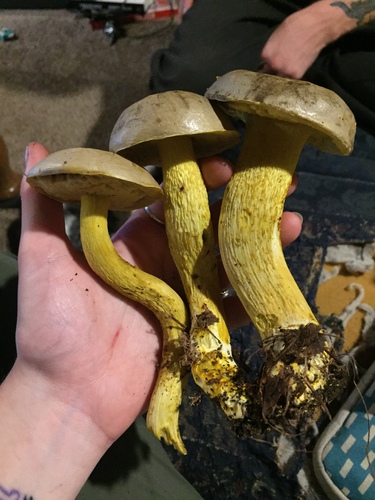
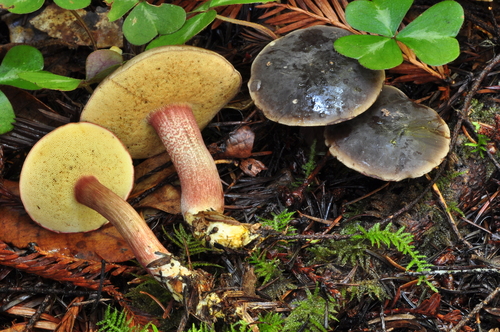
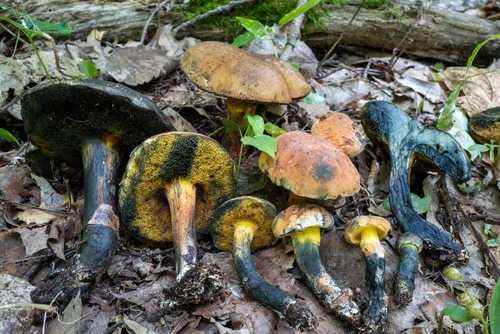
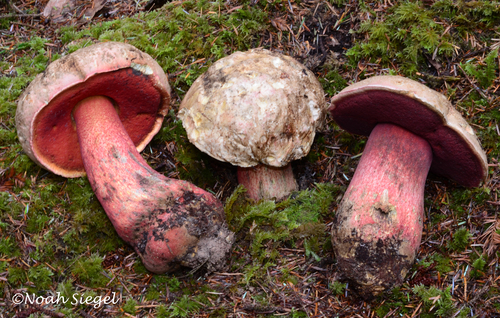
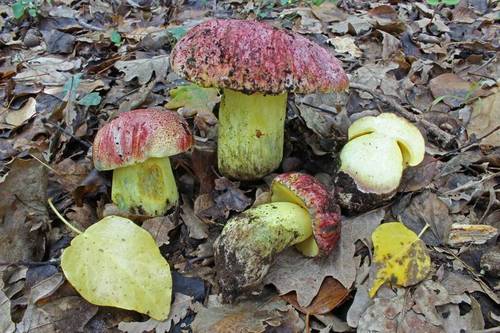
Butyriboletus regius has caps that are either convex or flat, reaching 6–20 cm (2+1⁄4–7+3⁄4 in) in diameter. The cap surface ranges from pink to red, and occasionally shows hints of yellow or brown, which are most prominent around the margin. Young caps are initially velvety to slightly tomentose (hairy), but these tiny hairs typically wear away as the mushroom ages, and the cap develops wrinkles and pits. The cap flesh is yellow; in North American specimens, it usually bruises blue slowly and erratically, while in European specimens it does not stain when exposed to air, or stains only weakly. The angular pores on the underside of the cap number about 1–2 per millimetre. Pore surfaces start bright yellow, eventually darken slightly, and stain blue when damaged. The pore-forming tubes are 0.8–2.5 cm (1⁄4–1 in) deep. The stem measures 5–14 cm (2–5+1⁄2 in) long and 2.5–6 cm (1–2+1⁄4 in) thick, and usually has a thick, bulbous base. It is solid (not hollow), bright yellow, and often has reddish tones, especially near the base. Fine yellow reticulations may cover the entire stem surface, or only appear on the upper portion. The spore print of Butyriboletus regius is olive-brown. The spores are smooth, hyaline (translucent), and roughly elliptical to somewhat fusoid (wider in the middle and tapering toward the ends) to more or less cylindrical, with dimensions of 12–17 by 4–5 μm. Chemical field tests can help identify this species: applying FeSO4 to the cap cuticle turns it pale purple, and the same test turns the mushroom flesh grayish. Butyriboletus regius is an ectomycorrhizal species with a broad host range, forming associations with oaks and conifers, especially fir. Its fruit bodies grow singly, scattered, or in groups. In North America, fruit bodies usually appear from August to November, though they can also appear between May and June. In North America, the species is distributed across the Pacific Northwest states of California, Oregon, and Washington, where its occurrence ranges from rare to locally abundant. It is rare in Europe, is listed on the Regional Red List of several European countries, and is considered endangered in the Czech Republic. This species has also been recorded in China. Both European and California populations of Butyriboletus regius are considered choice edibles, though California specimens are often infested with maggots.