About Butyriboletus fuscoroseus (Smotl.) Vizzini & Gelardi
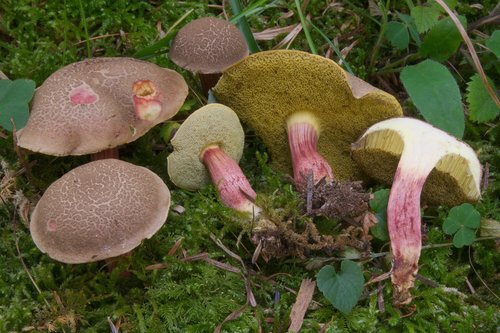
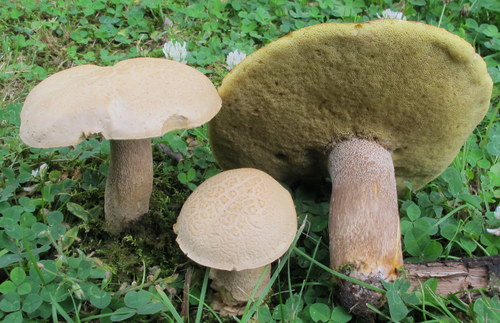
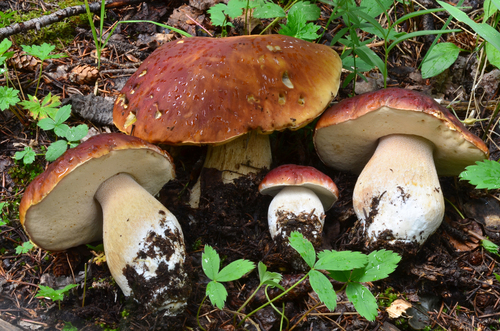
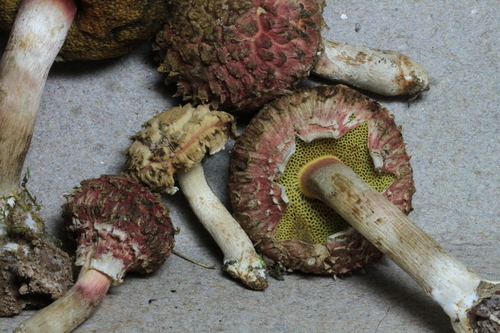
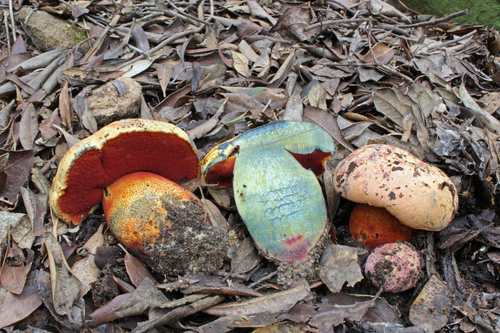
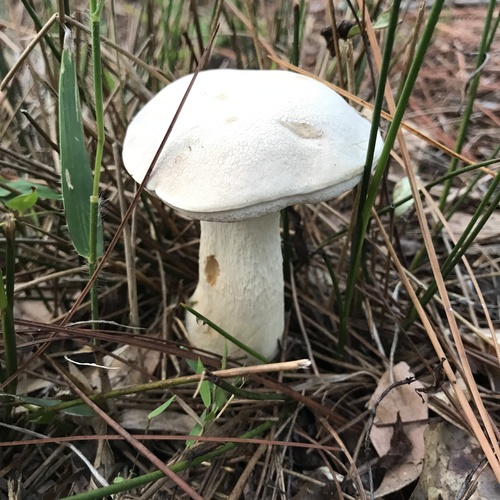
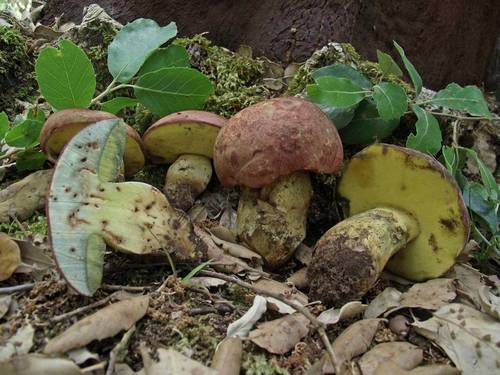
Butyriboletus fuscoroseus forms robust basidiocarps with convex caps (pilei) that can reach up to 20 cm across. Young caps start hemispherical before becoming flattened, and their colour ranges from violet-brown to reddish-brown, occasionally dull red; older specimens often fade to beige with a faint pink tint. The cap margin typically retains remnants of the partial veil, an appearance called appendiculate. Under the cap, the tubes are up to 1.5 cm long, bright yellow, and develop an olive tinge as they age. Both the tubes and pores bruise blue when handled. The stipe is stout, reaching up to 10 cm long and 3 cm thick, with a shape ranging from cylindrical to club-shaped. It is yellow near the apex and tinged pink to red toward the base, usually covered in well-developed reticulation that matches this pink to red colour, and it also bruises blue when handled. The context (flesh) is whitish in the cap and lemon yellow in the stipe, shading to clay pink at the stipe base, and turns blue when exposed to air. The odour is indistinct in young fruit bodies, but may become medicinal or paint-like when mature; dried specimens have an odour that can resemble smoked meat or chicory. The taste is mild to slightly acidic. Microscopically, the spores are ellipsoid, measuring approximately 10–14.5 × 4–5.5 micrometres, with each spore holding one to three large oil droplets. The spore-bearing basidia are club-shaped and four-spored, and cystidia measure roughly 36–52 × 9–14.5 μm. The cap surface (pileipellis) is a trichoderm made of interwoven, slightly incrusted hyphae with rounded terminal cells. Chemical spot tests produce only slight reactions with ammonia (NH4OH) and potassium hydroxide (KOH) solution, and no colour change with iron(II) sulphate (FeSO4) or Melzer's reagent. This species produces fruiting bodies in warm, dry to moderately moist broadleaf woodlands, most often under oak (Quercus spp.), and frequently grows on calcareous soils at elevations from near sea level up to around 800 m. In Bulgaria, fruiting occurs from June through September, during the summer season. Confirmed localities within Bulgaria are along the Southern Black Sea coast, the Eastern Forebalkan, the western and eastern flanks of the Stara Planina mountains, the Sofia region, and the Eastern Rhodope range. Outside of Bulgaria, it occurs across most of southern and central Europe, including Austria, Belgium, the Czech Republic, France, Greece, Hungary, Italy, Spain, and the Balkan states, and its range extends into Turkey.