About Butyriboletus appendiculatus (Schaeff.) D.Arora & J.L.Frank
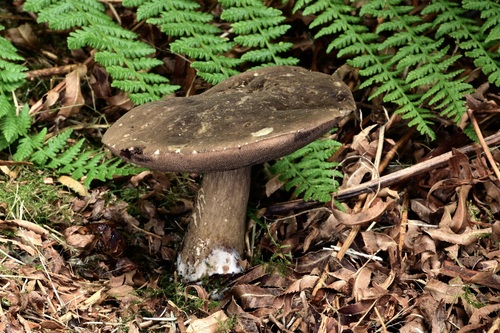
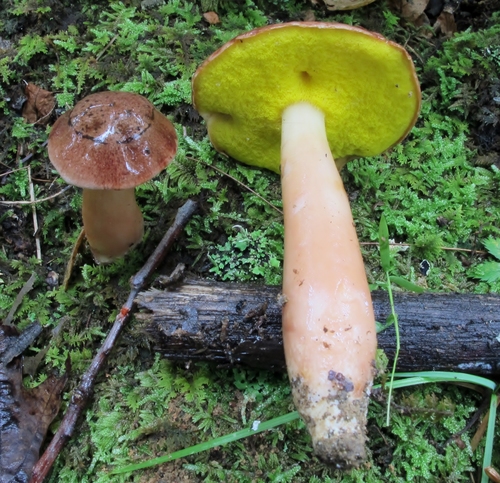
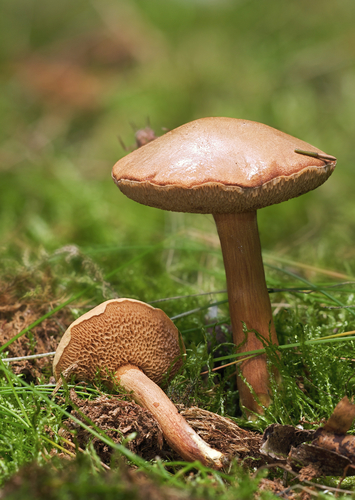
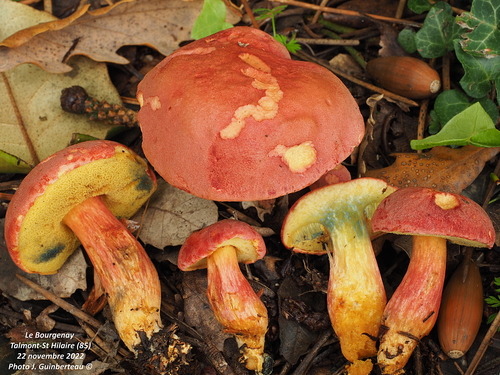
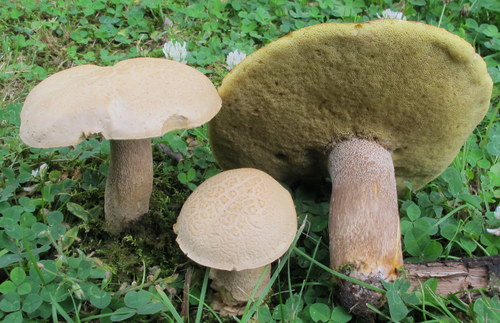
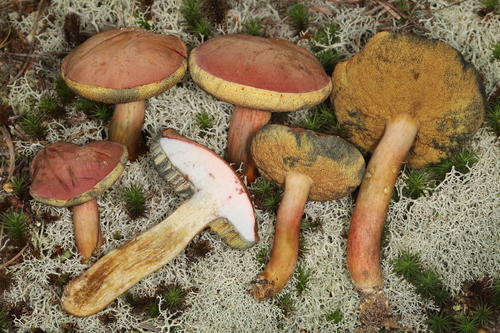
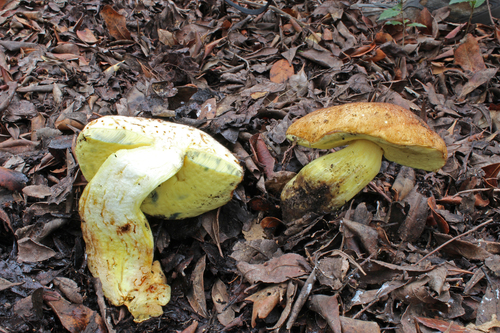
The fruit bodies of Butyriboletus appendiculatus have brown to yellowish brown caps that range from convex to flattened, and measure 6–20 cm (2.4–7.9 in) in diameter. The cap surface is dry to slightly sticky, and may develop cracks as the mushroom ages. The flesh is very firm and yellowish, and may slowly turn blue when cut or bruised. The pores on the undersurface of the cap are butter yellow, and can also bruise blue, though this reaction is less common in young specimens. The stipe measures 5–15 cm (2–6 in) long and 2–6 cm (0.8–2.4 in) thick at its upper end where it attaches to the cap. Its overall shape varies from thicker at the base, to equal in width from top to bottom, to tapered toward the bottom. The stipe is also yellow, sometimes develops brownish to reddish stains, and may have fine reticulations near its top. The spore print of this species is dark olive-brown. Individual spores are ellipsoidal to spindle-shaped, smooth, and sized 12–15 by 3.5–5 μm. Butyriboletus appendiculatus is distributed in Europe and North America. Its fruit bodies grow singly, scattered, or in groups under hardwood trees. In North America, it is most common in the Pacific Northwest, where it often grows in association with live oak and tanoak.