About Butia odorata (Barb.Rodr.) Noblick
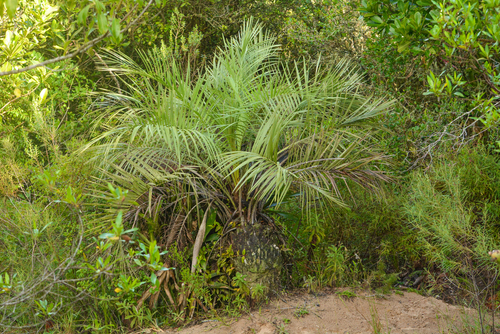
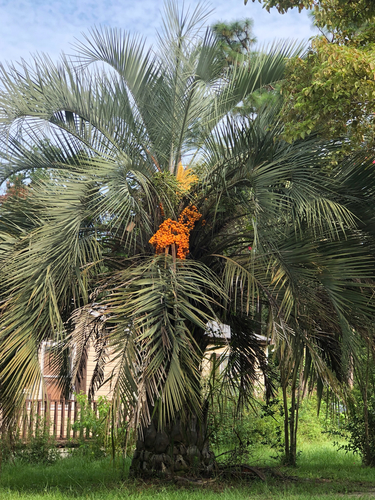
Butia odorata, commonly called the South American jelly palm, jelly palm, or pindo palm, is a Butia palm native to the southernmost regions of Brazil and Uruguay. This is a slow-growing palm that reaches a maximum height of 10m, though it often grows shorter. It can be identified by its pinnate feather palm leaves, which arch inward toward its thick, stout trunk.
This species is native to southern Rio Grande do Sul, Brazil, ranging from the municipalities of Palmares do Sul and Porto Alegre south to Treinta y Tres and Rocha Department in northern Uruguay. Bauermann et al. studied whether palm pollen including this species could be used in palynology, to uncover more details about ancient habitat changes in the Brazilian state of Rio Grande do Sul by tracking changes in palm distribution and abundance, but the study did not yield much detailed insight on the topic.
It grows in a coastal band across southernmost Brazil that extends into Uruguay. Within this region, it occurs in restinga habitat in coastal hilltop fields. It may also grow in pampa grasslands, seasonally semi-deciduous Atlantic forest, and rocky outcrops. It prefers sandy or rocky, often dry soils such as those found in stabilized dune formations, and does not grow in more humid habitats. It typically grows in small aggregated clusters, and these palm groves are known locally as butiazais or butiatubas. It grows at altitudes between 0 and 500 meters.
Although this species is widely planted across southern Europe, the United States, and other regions outside its native range, it has rarely been recorded escaping cultivation or becoming naturalized. In 2000, Scott Zona wrote in Flora of North America that B. odorata showed little tendency to escape cultivation. However, as of 2018 the USDA PLANTS database lists the species as naturalized in the U.S. states of Florida, North Carolina, and South Carolina. In 1996, the unpublished Flora of the Carolinas and Virginia, the reference used by the PLANTS database, recorded the species (listed under the synonym B. capitata) as present in coastal North and South Carolina. By 2004 this flora had been expanded to cover Georgia, and by 2008 it covered northern Florida; in these updated versions, it noted that the palm (still listed as B. capitata) was not naturalized in the region, but was widely planted along the coastal strip of southeastern North Carolina, eastern South Carolina, eastern Georgia, and northern Florida. These cultivated plants often persist even when neglected, and can appear naturalized in superficially semi-natural locations. The first confirmed record of naturalized B. odorata in this region was published in 2018, based on specimen vouchers collected in 2007 from young plants growing some distance from human habitation in Camden County, in the far southeastern corner of Georgia. This palm was considered naturalized in Florida by an anonymous source by at least 2009, and was added to the USDA PLANTS database at that time. This classification was validated in 2010 with the publication of the first confirmed naturalized population, documenting a 2005 specimen collection in the dunes of Chinsegut Wildlife and Environmental Area in Hernando County, a former farm and estate that includes planted Butia palms. An additional unvouchered record of naturalized B. odorata in Silver River State Park, Marion County, Florida was published in 2013. As of 2018, the Atlas of Florida Plants notes that voucher specimens identified as B. capitata (with a caveat about the identification) have been collected in central and northern Florida counties: Hernando, Volusia, Washington, Liberty, Gadsden, Leon, and Wakulla.
Butia odorata often acts as a host for the epiphytic fig species Ficus cestrifolia; local people often believe the fruit produced by these figs are much sweeter than average. It also hosts two species of lichen: Cladonia ahtii and C. palmicola. C. palmicola was first collected in 1989, formally described in 1995, and as of 2012 has only been found growing on the trunks of Butia trees along the coast from Santa Catarina State, Brazil to Uruguay. In a 1974 study in Uruguay, caterpillars of the butterflies Blepolenis batea and Opsiphanes invirae (either the nominate form or possibly the subspecies remoliatus) were recorded feeding on this palm, which was classified as Syagrus capitata in that study. The caterpillars of the Indonesian butterfly Cephrenes augiades augiades and the Australian butterfly C. trichopepla may also feed on the leaves of this palm.
It is cultivated as a fruit tree in Brazil and Uruguay. Larger-fruited, semi-domesticated pulposa-type plants are particularly common in local orchards. Ripe fruit of the type most often grown in the United States are around the size of a large cherry, yellowish-orange in color, and may have a reddish blush near the tip. The taste is described as a mix of pineapple, apricot, and vanilla; taste varies based on soil conditions, and a combined taste of apple, pineapple, and banana is also common. The fruit is both tart and sweet, with flesh similar in texture to loquat, but slightly more fibrous.