About Butia catarinensis Noblick & Lorenzi
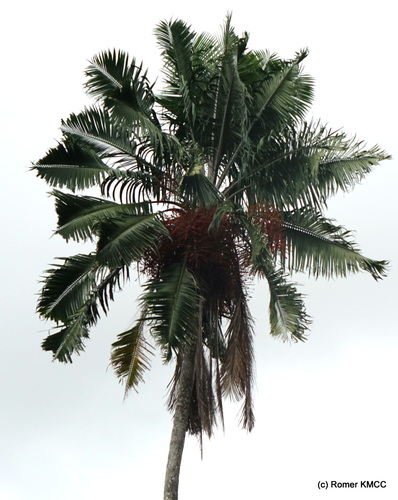
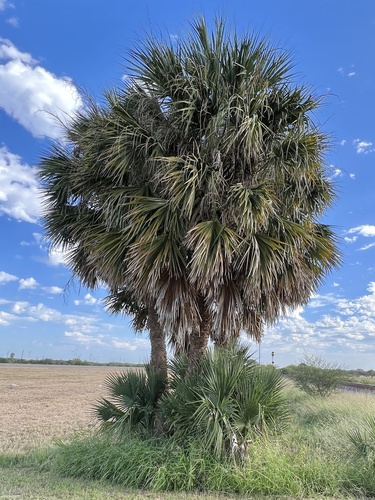
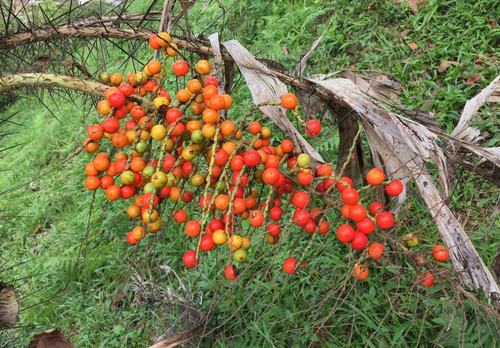
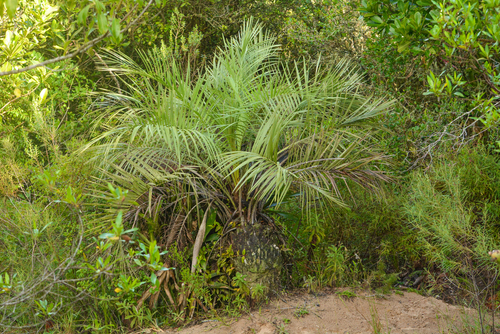
Butia catarinensis Noblick & Lorenzi is a single-trunked palm. Its trunk grows 0.2–2 m (0.7–6.6 ft) tall, exceptionally reaching 4 m (13 ft), with a diameter of 15–43 cm (5.9–16.9 in). The trunk stays covered in the persistent bases of old fronds. The palm has 9 to 32 fronds, arranged in a spiral around the trunk. The leaf blade measures 50–120 cm (20–47 in) by 7–15 cm (3–6 in). The petiole is glabrous (hairless), 18–64 cm (7–25 in) long, 1.5–2.4 cm (0.59–0.94 in) wide, flat on the upper surface and rounded elsewhere. Petiole margins are densely toothed with numerous strong spines up to 4 cm (1.6 in) long, and hold many flattened fibres when leaves are young. The leaf rachis is 65–190 cm (26–75 in) long, and carries 48 to 62 pairs of glaucous pinnae (leaflets) arranged uniformly along the rachis. Unlike most Butia species, except B. odorata, these pinnae usually lie in the same plane; they are sometimes inserted at very slightly divergent angles along the rachis, but do not give the leaf a plumose appearance like that of Syagrus palms. Each pair of pinnae forms a distinct neat V-shape. Pinnae in the middle of the leaf blade are 35–75 cm (14–30 in) long and 1.3–2.3 cm (0.51–0.91 in) wide. The inflorescence is branched once, with a 29–77 cm (11–30 in) long peduncle 1.6–1.9 cm (0.63–0.75 in) wide, and a 19–47 cm (7.5–18.5 in) long prophyll 3.2–5.5 cm (1.3–2.2 in) wide, covered in brown tomentum. Young inflorescences develop inside a glabrous, lightly striated, woody spathe that is 65–110 cm (26–43 in) long. The spathe has an enlarged section at its end, 33–73 cm (13–29 in) long and 8–17 cm (3.1–6.7 in) wide, that ends in a short, sharply pointed tip. The inflorescence axis is 30–60 cm (12–24 in) long. The inflorescence rachis is 72–186 cm (28–73 in) long, and bears 35 to 135 rachillae (inflorescence branches) that are 10–45 cm (3.9–17.7 in) long. Flowers may be yellow, greenish-yellow, yellow with violet, or fully violet. Staminate (male) flowers are 9–10 mm long; pistillate (female) flowers are 5–10 mm long. Both the fruit and nut have an ovoid shape. Ripe fruit are yellow, orange, or red. Fruit are 1.4–2.2 cm (0.6–0.9 in) long and 1.2–2.6 cm (0.47–1.02 in) wide, with a persistent perianth and yellow, juicy, lightly fibrous flesh. The nut is hard, 1.2–1.4 cm (0.5–0.6 in) long, 0.8–1.2 cm (0.3–0.5 in) wide, dark brown, and contains a homogeneous endosperm. It holds 1 to 2, rarely 3, seeds, and has no beak or other protuberance on its apex. This species is native to the Brazilian states of Santa Catarina and Rio Grande do Sul. It grows in coastal lowlands within a relatively narrow strip along the coast, from the municipality of Araquari in Santa Catarina to Osório in Rio Grande do Sul. It is typically found not far from the coast in restinga, a type of dry coastal tropical thorn-scrub. It grows on coastal dunes and older stabilised dunes further inland, and appears to prefer densely vegetated or wooded environments. It grows in sandy and rocky soils. In its native range in Brazil, the edible fruit of this palm are collected for a wide variety of uses.