About Buteo trizonatus Rudebeck, 1957
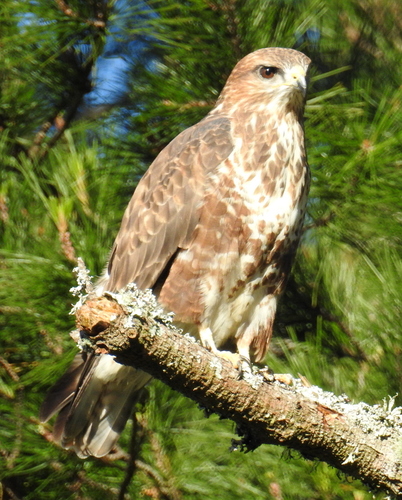
The forest buzzard (Buteo trizonatus Rudebeck, 1957) is very similar to the abundant summer migrant steppe buzzard Buteo buteo vulpinus. Its head, back, and upperwings are brown, with feathers marked by rufous edges that vary in extent between individual birds. The chin is whitish and unmarked; the breast and belly are whitish but marked with a variable amount of brown spots, and the undertail coverts are plain whitish. Plumage varies among individuals: some adults have brown barring along the breast sides and belly, while all except the palest birds show a distinctive white 'U' mark in the middle of the otherwise blotched abdomen. The underwings are white, with a reddish-brown tinge on the lesser underwing coverts and a dark comma-shaped mark at the tip of the primary coverts. The plumage on the thighs is uniformly reddish-brown, and the axillary feathers are white with brown barring. The upper tail is brown with a reddish-brown wash, marked with multiple narrow dark brown bands and a broad dark brown subterminal band; undertail bands may be indistinct. This species has a body length of 41–48 cm (16–19 in) and a wingspan of 102–117 cm (40–46 in).
In terms of distribution and movements, the forest buzzard is endemic to South Africa, Lesotho and Eswatini, where it occurs in an arc from the mountains of eastern Limpopo Province south through the Drakensberg of Kwazulu-Natal to the Western Cape. It is at least a partial migrant, and acts as a winter visitor (present from June to August) in the Drakensberg of Eastern Cape northwards, an area where there are no breeding records for the species. Two birds ringed in the eastern region (Kwazulu-Natal and Mpumalanga) were later recovered in the south of South Africa, having moved between 800–1,300 km (500–810 mi).
As its common name suggests, the forest buzzard inhabits evergreen woodlands, including introduced stands of eucalyptus and pines, while the steppe buzzard prefers more open habitats. Even so, habitat alone is not a reliable indicator to distinguish these two species.