About Buteo swainsoni Bonaparte, 1838
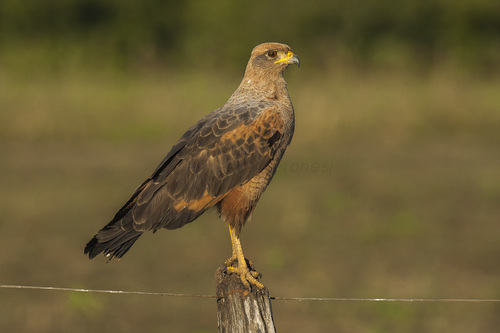
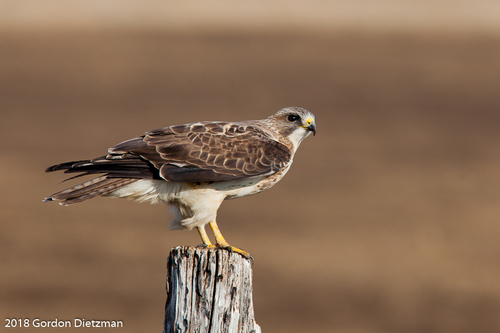
Swainson's hawk (Buteo swainsoni) is a medium-sized raptor in the genus Buteo. Its size broadly overlaps with that of the related red-tailed hawk (B. jamaicensis), a breeding resident found across almost all of North America. On average, Swainson's hawk is slightly shorter in total length, measuring 43–56 cm (17–22 in), and weighs a bit less, at 0.5–1.7 kg (1.1–3.7 lb). However, it has a slightly longer wingspan than the red-tailed hawk, at 117–137 cm (46–54 in), along with more slender, elongated wings. Female Swainson's hawks are somewhat larger and heavier than males, with an average weight of 1.15 kg (2.5 lb) compared to the male average of 0.81 kg (1.8 lb). Standard measurements for the species are as follows: wing chord 36.2–42.7 cm (14.3–16.8 in), tail 18.5–23.4 cm (7.3–9.2 in), tarsus 6.2–8 cm (2.4–3.1 in), and bill (measured from the gape) 3–3.5 cm (1.2–1.4 in). When in flight, Swainson's hawk holds its wings in a slight dihedral, and tips back and forth slightly while soaring. There are two main color morphs for the species. Over 90% of individuals are light-morph, while the dark morph is most common in the far western portion of the species' range. Light-morph adult Swainson's hawks have white underparts, a dark reddish "bib" on the chest, and a distinct white patch on the throat and face. When the bird soars, its underwings show light leading edges (linings) and dark trailing edges (flight feathers), a pattern that is unique among North American raptors. The tail is gray-brown with around six narrow dark bands and one wider subterminal band, and the upperparts are brown. Juvenile light-morph Swainson's hawks are similar to adults, but their dark areas have pale mottling, their light areas (especially the flanks) have dark mottling, the chest is pale with some darker markings, and the tail's subterminal band is less obvious. Birds in their first spring may have pale heads due to feather wear. Dark-morph birds are dark brown all over except for a light patch under the tail. A rufous variant of the dark morph exists that is lighter on the underparts with reddish bars. The tails of both dark morph variants match the tail pattern of the light morph. Swainson's hawk mainly inhabits North America during spring and summer, and winters in South America. Its breeding range includes south-central Alberta, central Saskatchewan, southwestern Manitoba, and western and southern Minnesota. It breeds as far north as east-central Alaska and southwestern Yukon. Breeding range extends south through the eastern parts of Washington and Oregon, and locally reaches California's Central Valley, Arizona, New Mexico, Colorado, and most of Texas. The eastern portion of the breeding range includes Minnesota, northwestern Iowa, most of Nebraska, Kansas, and Oklahoma, and all of Texas except eastern Texas. It occurs periodically in Iowa, and rarely in northwestern Missouri, northern Illinois, and southwestern Wisconsin. Small populations of Swainson's hawk winter in southeastern Florida and along the Texas coast, likely because these individuals did not find a route south around the Gulf of Mexico. Individuals reported north of these wintering areas in winter (for example, on Christmas Bird Counts) are almost always misidentified buteos of other species. Most Swainson's hawks winter on the pampas of South America, in Argentina, Uruguay, and southern Brazil. Populations breeding in California's Central Valley also winter in western Mexico and Central America. Swainson's hawk has the second longest migration of any North American raptor, outranked only by arctic-nesting peregrine falcons. The journey from breeding grounds to South American pampas in southern Brazil or Argentina can be as long as 7,100 mi (11,400 km), and each migration can last at least two months. Swainson's hawks leave their breeding grounds between August and October. Fall migration begins on any clear day when the wind blows in the general direction of travel. The birds gain altitude by soaring in circles on rising thermals, then set their wings and close their tails to glide, slowly losing altitude until they find another thermal to rise with. This creates a pattern where waves and small groups of migrating birds are strung out across the sky. The birds gradually travel south toward Central America, where nearly the entire population funnels through the Isthmus of Panama. Concentrations of migrating Swainson's hawk at sites like Ancon Hill, Balboa, and Panama City are spectacular. In the Andes, the species migrates along a narrow corridor and rarely strays off course; for example, it was only recorded in Colombia's Serranía de las Quinchas, around 100 km (62 mi) off its usual migration route, in 2000/2001. In Brazil, migrating birds pass through the western states of Acre and Mato Grosso, while wintering birds may stray to the southern states of Paraná, Rio Grande do Sul and São Paulo. Surprisingly, occasional Swainson's hawks, including one- to two-year-old birds, have also been recorded in the eastern Brazilian states of Maranhão, Pará, Pernambuco, Piauí and Tocantins, thousands of kilometers from their usual migration route and wintering grounds, and sometimes in mid-summer. This suggests that individuals occasionally become lost during migration, and/or may spend an entire year ranging through tropical regions rather than only overwintering at a single site. In Uruguay, the first dedicated studies of wintering Swainson's hawk show it is not uncommon but patchily distributed across the country in winter. It was notably underreported in Flores and Paysandú Departments, where it is actually a regular visitor. In recent years, the first wintering birds arrive in early November, and some stay until late February. Numbers increase through November and peak in December, when flocks of several dozen forage across open land. Many individuals stay for only a few weeks before leaving again. Spring migration broadens after the birds pass through Mexico, as they disperse across their breeding range. Migrant groups are recorded in southern U.S. states in March. The earliest Swainson's hawks arrive in southern Canada in late March, with migration peaking starting in mid-April. In both breeding and wintering ranges, Swainson's hawk lives in open and semi-open country, including deserts, grasslands and prairies. It favors wild prairie, hayfields, and pastures over wheat and alfalfa fields, which provide too much cover for its prey. It requires elevated perches for hunting, and a supply of small mammals (such as young ground squirrels) as prey for its nestlings. Because of this, the species' breeding distribution is very closely tied to the distribution of various small mammals; for example, in Saskatchewan, the distribution of Richardson's ground squirrel and Swainson's hawk is exactly the same. Swainson's hawk will defend its breeding territory from other buteos. Breeding densities vary by area but average one pair per 2.5 sq mi (6.5 km2). The average estimated home range for this hawk is 1 to 2 sq mi (2.6 to 5.2 km2). It gathers in groups for feeding and migration, but these gatherings are not social, and are instead motivated by good feeding or migration conditions. Swainson's hawk, red-tailed hawk (B. jamaicensis) and ferruginous hawk (B. regalis) compete for territory, and defend territories against each other. In many parts of the Great Plains, these three species nest in the same general area and exploit much the same prey base. Although their diets overlap greatly, their habitats may not overlap as much. In Oregon, Swainson's hawk selects nesting trees with a different configuration than those used by red-tailed or ferruginous hawks. In southern Alberta, different nesting habitats help reduce food competition: Swainson's hawk favors areas with scattered trees or riparian borders, while red-tailed hawks nest in stands of tall trees, and ferruginous hawks nest on the open plains. Nests of Swainson's hawk that are placed close to nests of these two other buteo species may have reduced reproductive success. Swainson's hawk is generally tolerant of people. It is attracted to haying, mowing, and plowing operations. Small birds like house sparrows and European starlings may nest in or near a Swainson's hawk's nest. In its winter range, the species is far more tolerant, though most individuals still forage on their own. In Uruguay, Swainson's hawk prefers largely open but broken plains or low hills (with rocks or woods), where it can gather in larger groups. Groups of a few dozen birds are not uncommon, and flocks of over one hundred birds have been recorded multiple times; one such flock was recorded roaming the Cuchilla Marincho region south of Andresito, Flores Department, in mid-late December 2005. When Swainson's hawks arrive at their nesting sites in March or April, they often return to their original nests, as the species is monogamous. Research shows they have a high degree of fidelity to both mates and territories, which is unusual for a long-distance migrant. Seven to fifteen days after arriving at the nesting site, males begin constructing nests, which may be built on the ground, on ledges, or in trees. Nests are made of twigs and grasses, and can take up to two weeks to complete. Pairs may build new nests, refurbish old nests of their own, or refurbish abandoned nests built by other species, most commonly corvids such as common ravens, black-billed magpies, and American crows. The courtship displays of Swainson's hawk are not well studied. One observed courtship activity involves circling and diving above a potential nest site, flashing the underwings and rump, and calling. The display may end with one bird diving to land on the edge of the nest. Copulation occurs mainly in the morning and evening, on dead tree limbs. The female may assume a receptive position without a prior display, and one of the pair calls during copulation. Swainson's hawks typically nest in isolated trees or bushes, shelterbelts, riparian groves, or around abandoned homesteads. Occasionally, a pair will nest on the ground, a bank, or a ledge. Common nest plants include ponderosa pine, Douglas-fir, spruce, cottonwood, domestic poplar, aspen, elm, mesquite, willow, saguaro cactus, and soaptree yuccas. Nests are located 9 to 15 ft (2.7 to 4.6 m) above the ground, usually in the shaded canopy near the top of the tree. Nests are flimsy structures, usually smaller than red-tailed hawk nests, and often blow down after the nesting season ends. Clutch size ranges from one to four eggs, and averages two to three. Each egg is elliptical, about 2.25 in (57 mm) long and 1.8 in (46 mm) wide. The egg shell is smooth with fine granulations, and has a white base color that is often tinted bluish or greenish. During incubation, the shell color quickly fades to dull white. Some eggs are plain, while others are lightly marked with light brown spots and blotches. The incubation period lasts 34 to 35 days; the female incubates the eggs while the male brings food. Young Swainson's hawks are fed small, young mammals. Flight feathers begin to emerge when the young are 9 to 11 days old. High nestling mortality often occurs when young are 15 to 30 days old, and is frequently a result of fratricide. Young begin leaving the nest to perch on surrounding branches at 33 to 37 days, and fledging occurs at around 38 to 46 days. Fledglings remain dependent on their parents for 4 to 5 weeks. This species raises one brood a year, and apparently does not lay replacement clutches if a brood is lost. Swainson's hawks hunt using a variety of methods. Many hunt from perches, watching for prey movement from an elevated spot such as a tree, bush, pylon, telephone pole, or hummock. Others hunt by soaring over open ground with wings held in a dihedral, using their sharp vision to spot prey activity below. It occasionally flies low over the ground like a northern harrier (Circus cyaneus) or hovers like a rough-legged hawk (B. lagopus) while hunting. They frequently use transect-glides when actively hunting in flight. It commonly perches on the ground both during migration and on the breeding grounds. When hunting on the ground, which is almost entirely for large insects, its gait can appear awkward, but it is often successful in capturing several insects per day. During migration, it typically roosts overnight on bare ground with scattered trees, a habit that distinguishes it from other long-distance migrant buteos such as the broad-winged hawk (B. platypterus), which roosts in closed-canopy woodlands. These birds patrol open areas or scan for prey from a perch, and may also catch insects in flight. They take advantage of insects uncovered by farm equipment or driven out by fire. A hunting Swainson's hawk uses multiple strategies. It hunts flying insects such as dragonflies or dobsonflies, flapping very little as it rides wind currents and stoops on the insect, grabbing it with its foot and immediately transferring the prey to its bill. It uses a similar strategy to grab individual free-tailed bats from flying streams of bats. When large groups of dragonflies are grounded by bad weather, Swainson's hawk will stand near groups sheltering from the wind and pick off individual insects. Swainson's hawk closely follows both tractors and wild fires to feed on injured or fleeing prey. It will also run down insect prey on the ground. Occasionally a hawk will stand still on a dirt bank or elevated mound waiting for prey to appear. It commonly hunts from elevated perches such as telephone poles, and stoops on prey when it is sighted. Swainson's hawks are largely insectivorous except when nesting. Common insect prey includes grasshoppers, crickets, and locusts. Other buteo hawks in this species' range, including smaller-bodied species, do not normally prefer insects in their diet, instead focusing on rodents and other small vertebrates. However, breeding birds switch mainly to hunting vertebrate prey to bring to their nestlings. Breeding Swainson's hawks rely heavily on small mammals such as young ground squirrels, young cottontails, pocket gophers, mice, young jackrabbits, and, at least locally, small birds and other vertebrates including reptiles and amphibians. Bird species taken include large birds such as Mallards and Sage Grouse, which usually were already injured. Other less common bird prey includes American kestrel and young short-eared owls. More typical-sized prey includes young lark buntings just after fledging. Reptiles, which can make up a large portion of the diet, include snakes such as racers, gopher snakes and striped whipsnakes, as well as lizards. Amphibian prey includes tiger salamanders and toads. Swainson's hawk is an opportunitive feeder that responds quickly to local concentrations of food. In Argentina, flocks of immature Swainson's hawks feed on flocks of the migratory darner dragonfly Rhionaeschna bonariensis, following the hordes of insects and feeding mostly on the wing. Local locust outbreaks may also be exploited for food by one or more age classes of birds. Immatures wintering in southern Florida apparently feed on insects, mice, or both, when these are uncovered by field plowing, moving from one freshly ploughed field to the next. There is also some evidence that road-killed birds and animals are consumed both on the wintering and breeding grounds. The species commonly follows tractors and other agricultural equipment during haying or ploughing, where rodents are exposed for hawks to capture, or insects are uncovered after crop cutting. Wildfires often attract foraging Swainson's hawks, especially grass fires in their South American wintering range. In South American grass fires, hawks frequently wait around the edges of the fire to pick off both insects and vertebrates including nothuras, lizards and snakes.