About Buteo rufinus (Cretzschmar, 1829)
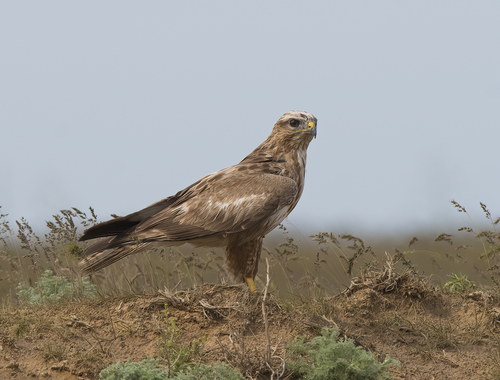
Identification: Pale individuals of the long-legged buzzard (Buteo rufinus) are usually fairly distinctive, but high variation in their plumage often leads to misidentification. The most common confusion is with the even more plumage-variable common buzzard (Buteo buteo), particularly the steppe subspecies, which breeds and migrates in many of the same areas. Steppe buzzards can be distinguished from long-legged buzzards by several plumage traits: a darker head and chest paired with a contrasting paler breast band, fully barred darker uppertails, a less distinct carpal patch on both the upper and lower wing surfaces, more contrasting wing lining with paler median coverts and darkest greater coverts. Due to the extensive plumage variation in steppe buzzards, reliable identification is often not possible, and for distant sightings, the most reliable distinctions are smaller size and different body proportions. Steppe buzzards are distinctly smaller, more compact, and have noticeably shorter wings and tails than nominate long-legged buzzards. Additionally, steppe buzzards have a more prominent head, a less protruding bill, and fly with faster, stiffer, less flexible wing beats. When gliding, steppe buzzards hold their wings flatter, and form a less pronounced dihedral without wing tips pointed upward. Dark morphs of the two species are so similar that they can only be told apart by size, proportions, and flight behavior. The smaller North African subspecies of steppe buzzard is especially difficult to distinguish from long-legged buzzard. In Asia, the long-legged buzzard is similar in appearance to the upland buzzard, which averages slightly larger in size but has somewhat narrower wings. Upland buzzards typically have a large white patch on the upper hand of the wing, a uniform greyish white tail (with at most 2-3 dark bars that are only visible at close range), darker, more earthen brown coloring on the breast and thighs, and lack the warm, rufous tones typical of long-legged buzzards. Dark morph upland buzzards may have a darker ground color on the under secondaries and sometimes show a pale U-shape on the breast, but are otherwise almost identical in appearance to dark morph long-legged buzzards. The only other Buteo species that can potentially be confused with the long-legged buzzard is the migratory rough-legged buzzard (Buteo lagopus), which is similar in size, proportions, and flight behavior, including the ability to hover. However, rough-legged buzzards are marginally smaller, with shorter legs and a shorter bill. They can be distinguished from long-legged buzzards by a distinctive white-based tail with a broad dark subterminal band, and fully feathered legs. Juvenile rough-legged buzzards also lack the dark underwing diagonals seen in many juvenile long-legged buzzards. The long-legged buzzard may also be confused with other medium or large raptors that are not in the Buteo genus, including multiple species of small to mid-sized eagle and two species of honey buzzard. However, all of these species usually have a number of distinctive morphological features, especially in the proportions and shapes of their wings, head, and tail, as well as differing flight behavior and plumage traits that easily separate them from even the most similarly colored and similarly sized long-legged buzzards.
Distribution and habitat: The long-legged buzzard lives in arid areas of northern Africa, southeastern Europe, and west and central Asia, ranging east to China and south as far as central India. The westernmost extent of its breeding range is in west Africa: Western Sahara, extreme northern Mauritania, most of Morocco west to northern Algeria (with scattered occurrence elsewhere in Algeria), Tunisia, and northern Libya (mainly the northwestern part). Long-legged buzzards occur accidentally in several other parts of Africa. On mainland Europe, the species nests mainly in the southeastern region. Nesting long-legged buzzards have been recorded in eastern Hungary, central and eastern Ukraine, southern Moldova, southern and far eastern Romania, southern Serbia, broadly across Bulgaria, and to a smaller extent in northern Greece. Recent sightings confirm a small population in the Apulian region of southeastern Italy. There are also increasing records of long-legged buzzards in far southern Spain, with the first nesting recorded in Gibraltar in 2009. This recent expansion into southern Europe is tied to a warming climate that makes the region more suitable for the species. Vagrant, accidental long-legged buzzards have been documented multiple times across many parts of Europe, including Finland, Denmark, the Netherlands, France, Poland, the Czech Republic, and Slovakia. Outside of Europe in the eastern Mediterranean and Asia Minor, the long-legged buzzard is one of the most continuously distributed and abundant resident breeding raptors, found throughout all of Turkey, Cyprus, Armenia, Georgia, and Azerbaijan. Its range continues into southwestern Russia, reaching as far north as approximately Saratov and Orenburg. It is also widely and regularly distributed across much of the Middle East, residing across almost all of Syria, Lebanon, Israel, and the north-central parts of both Iraq and Iran. The breeding range extends more uncommonly into Oman, the United Arab Emirates, Yemen, and Saudi Arabia. The range continues across almost all of Central Asia, where the species lives in essentially all of Turkmenistan (including broadly along the Caspian Sea coast), Uzbekistan, all but the northernmost stretches of Kazakhstan, Tajikistan, Kyrgyzstan, and northern and central Afghanistan. The breeding range is discontinuous in northwestern China, but isolated breeding has been recorded in the Kashmir region, likely straddling both Pakistan and India. During migration, long-legged buzzards are seen across a broader area, including the Arabian Peninsula, southern Iraq, western China, and northeast Africa; individuals breeding in Europe, Russia, and Central Asia often leave their breeding grounds for the winter. The wintering range of migratory long-legged buzzards extends across much of lower Central Asia and the Indian subcontinent, including southern Afghanistan, most of Pakistan, and northern India through to Nepal, Bhutan, and Bangladesh. Vagrants have rarely been recorded as far south as Sri Lanka, northern Burma, and the Andaman Islands. Less consistent wintering populations may occur from central Sudan and Eritrea, northern South Sudan, most of Ethiopia, through far northeastern Uganda and central Kenya, and rarely into far northern Tanzania.
Habitat: The long-legged buzzard inhabits open, uncultivated areas, and favors nesting sites with high bushes, trees, cliffs, or hillocks, as well as access to freshwater. The species typically lives in steppe, semi-desert and desert edge, barren rocky landscapes, dry shrubland, and sometimes sea coasts. More occasionally, it will adapt to live in woodland areas as long as plentiful open spaces are available. Overall, slightly hilly plains are ideal nesting areas. In one study conducted in Iran, 41% of long-legged buzzards were found on open plains with low vegetation, 29% on plains with somewhat taller vegetation, 12% in mountain areas, and 18% in cultivated lands. While long-legged buzzards predominantly forage in wildlands, they are also adaptable to cultivations, pastures, village outskirts, and sometimes even heavily farmed areas. Grasslands are often primarily used during the winter. Individuals wintering in the Indian subcontinent largely use similar arid open plains, semi-deserts, and cultivated areas, but surprisingly are considered a characteristic wintering raptor of dry mixed forests with open glades and barren hill slopes. In the Indian subcontinent, the species may often use a variety of perches, including bushes, hedges, Acacia nilotica, sand dunes, haystacks, mounds, and power poles. The North African and Arabian race of long-legged buzzard reportedly has a strong preference for open wooded and/or rocky areas, but has been recorded in a similarly broad range of habitats as the nominate subspecies. The species occurs from sea level up to around 1,600 m (5,200 ft) in Europe, but in Asia it uncommonly lives in mountains at elevations of up to 3,000 m (9,800 ft), or even 3,900 m (12,800 ft); migrants have been recorded at elevations up to 5,000 m (16,000 ft). Younger birds disperse north of the main breeding grounds, and there are records of occurrence from Northern Europe. The breeding population in Greece numbers around 60 pairs. Reforestation in the Judean Hills in Israel and the West Bank is increasing potential interspecific conflict with other raptors in the area.