About Buteo regalis (G.R.Gray, 1844)
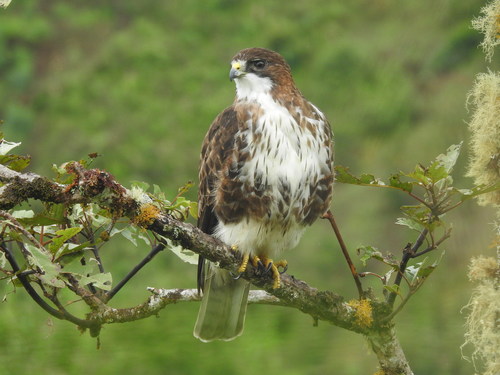
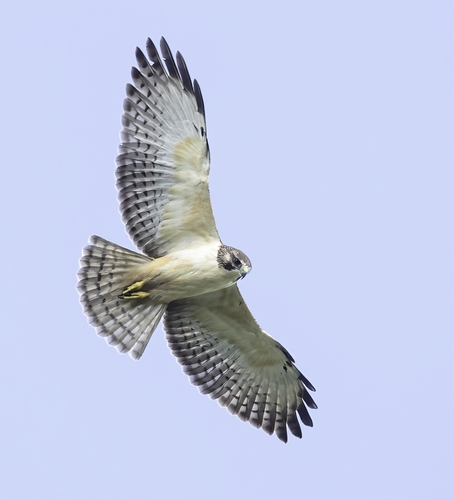
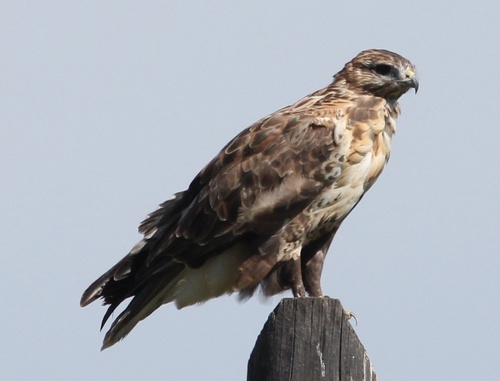
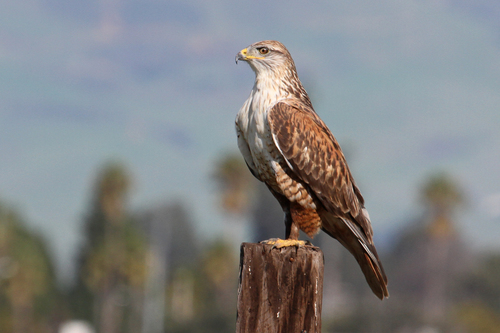
This species is the largest Buteo found in North America, and is often mistaken for an eagle due to its size, body proportions, and behavior. Among the nearly thirty Buteo species worldwide, only the Asian upland buzzard (B. hemilasius) averages larger in length and wingspan. The weight ranges of ferruginous hawks and upland buzzards overlap broadly, so which species is the heaviest in the genus remains debatable. Like all birds of prey, female ferruginous hawks are larger than males, though there is some overlap in measurement ranges between small females and large males. For this species, length ranges from 51 to 71 cm (20 to 28 in) with an average of 58 cm (23 in), wingspan ranges from 122 to 158 cm (4 ft 0 in to 5 ft 2 in) with an average of about 139 cm (4 ft 7 in), and weight ranges from 907 to 2,268 g (32.0 to 80.0 oz). Weight varies across the species' relatively restricted breeding range. In the southern part of the breeding range, which includes Arizona, New Mexico and Utah, males average 1,050 g (37 oz) based on a sample of fifteen individuals, and females average 1,231 g (43.4 oz) based on a sample of four. In the northern stretches of the breeding range, including southern Canada, Washington, Idaho and North Dakota, the hawks are heavier: males average 1,163 g (41.0 oz) from a sample of 30, and females average 1,776 g (62.6 oz) from a sample of 37. Average weights of upland buzzards fall between these two ferruginous hawk body mass datasets, being notably heavier than the southern ferruginous sample and lighter than the northern sample. In particular, the sample of 37 northern female ferruginous hawks places this species as the most massive Buteo in its northern populations. Adult ferruginous hawks have long broad wings and a broad gray, rusty, or white tail. Their legs are feathered all the way down to the talons, just like the rough-legged hawk. There are two distinct color forms. Light morph birds are rusty brown on the upper parts, and pale on the head, neck, and underparts, with rust color on the legs and some rust markings on the underwing; the upper wings are grey. The species' common name 'ferruginous' refers to the rusty coloration of light-morph birds. Dark-morph birds are dark brown on both upperparts and underparts, with light areas on the upper and lower wings. No subspecies of this species are recognized. Males and females have identical plumage markings; the main difference between them is size, with females being somewhat larger. When perched, light morph birds have a white breast and body with dark legs. The back and wings are a brownish rust color. The head is white with a dark streak extending behind the eye. The wingtips almost reach the tip of the tail. The underside is primarily light colored, with the dark legs forming a 'V' shape. The reddish color of the upper back extends to the inner wing-coverts, or 'shoulders'. The primary remiges (pinions) are dark gray with conspicuous light 'windows' in the inner primaries. Three prominent light areas on the upper surface stand out as two 'windows' on the outer wings and a rufous rump mark, which is considered the most significant identifying feature of a flying ferruginous hawk. The underwings are whitish overall with rufous markings, particularly in the patagial area. This gives the wings a smudgy appearance, but they are less dark than the underwings of a red-tailed hawk. The ferruginous hawk has noticeably longer wings than a red-tailed hawk; although the wings look slenderer than those of red-tailed hawks, the total wing area of ferruginous hawks is considerably larger. Even so, red-tailed hawks can be nearly as bulky and heavy. Prominent dark 'comma'-shaped markings are visible at the wrists. The ferruginous hawk is one of only two hawks that have feathers covering their legs down to their toes, a trait it shares with the golden eagle; the other Buteo with this trait is the rough-legged buzzard (Buteo lagopus). The pale morph of the closely related but more slender rough-legged buzzard is most easily distinguished by its darker coloration, a broad black tail band, and a dark band across the chest. The dark morph rough-legged buzzard is more slaty in color, compared to the browner tone of the dark morph ferruginous hawk. Swainson's hawks and especially rough-legged buzzards can have nearly as long wings as ferruginous hawks, but are less bulky and heavily built. Standard measurements for the species include a wing chord that measures 415 to 477 mm (16.3 to 18.8 in), a tarsus that measures 81 to 92 mm (3.2 to 3.6 in), and a tail that measures 224 to 252 mm (8.8 to 9.9 in). Additionally, the grasp measures 94 to 125 mm (3.7 to 4.9 in) and the third toe measures 29.5 to 45 mm (1.16 to 1.77 in), confirming that ferruginous hawks have the largest and most robust feet of any Buteo in the world. Compared to other Buteos, the ferruginous hawk also has a larger bill, which measures 37.6 to 49.5 mm (1.48 to 1.95 in), with a much wider gape when the bill is opened, at 42.7 to 57 mm (1.68 to 2.24 in). When in flight, these birds soar with their wings held in a dihedral. Ferruginous hawks prefer arid and semiarid grassland regions of North America as their habitat. This habitat includes open, level or rolling prairies, foothills or middle elevation plateaus that are largely free of trees, and cultivated shelterbelts or riparian corridors. Some habitats may feature rock outcrops, shallow canyons, and gullies. These hawks avoid high elevations, forest interiors, narrow canyons, and cliff areas. During the breeding season, they prefer grasslands, sagebrush, and other arid shrub country. Nesting occurs in open areas or in trees including cottonwoods, willows, and swamp oaks along waterways. Cultivated fields and modified grasslands are avoided during the breeding period. The density of ferruginous hawks in grasslands declines inversely to the degree of grassland cultivation, though high densities have still been reported in areas where nearly 80% of the grassland is under cultivation. Winter habitat is similar to that used in summer, but cultivated areas are not necessarily avoided, particularly when crops are not plowed under after harvest. The standing stubble provides habitat for the small-mammal prey base that ferruginous and other hawks need. One requirement for suitable habitat is the presence of perches such as poles, lone trees, fence posts, hills, rocky outcrops or large boulders. Ferruginous hawks nest in trees if they are available, including along riparian strips, but the presence of water does not appear to be critical for them. Ferruginous hawks maintain minimum distances from other nesting raptors, but will nest closer together when necessary, which means the minimum distance is not fixed. Nearest neighbor distances have varied from less than 1.6 km (1 mi) to as much as 6.4 km (4 mi), with an average of 3.2 km (2 mi). Nests facing different hunting territories are tolerated much closer together than nests facing the same hunting territory. The minimum distance between nests in densely occupied areas is probably about half a mile. Nesting densities from multiple studies have varied from one pair per 10 km² (4 sq mi) to one pair per 6,345 km² (2,450 sq mi). In Alberta, one study site recorded a stable average density of one pair per 10 km² (4 sq mi), with little deviation from this mean. In Idaho, the average home range for four pairs of ferruginous hawk in the Snake River area was slightly over 5.2 km² (2 sq mi). Copulation occurs during and after nest building. The egg-laying period varies with latitude, weather, and possibly food supply. In the Canadian portion of the range, laying occurs from the latter part of April through late June, while farther south laying occurs from around March 20 through mid May. The earliest recorded clutch was laid in January in Utah, and laying can occur as late as July 3 in Canada. Egg-laying happens at two-day intervals, and incubation starts when the first egg is laid. Incubation is shared by both sexes, with each taking approximately the same number of shifts during the average 32-day incubation period. Replacement clutches after nest failure appear to be rare. Formal courtship flights seem to be limited in the generally accepted sense. Both sexes engage in high circling flight, but existing literature has few detailed descriptions. Soaring activity is primarily likely to be variations of territorial defense flights, rather than courtship flights specifically. The 'flutter-glide' flight consists of a series of shallow, rapid wing beats interspersed with brief glides, and may function to advertise the territory. The 'sky-dance' is triggered by an intruder, and consists of slow flight with deep, labored wing beats, with irregular yawing and pitching that may end in steep dives. In the 'follow-soar' maneuver, the male ferruginous hawk will fly below an intruder and escort it out of the territory. High perching on prominent spots around the nest is common, especially early in the breeding cycle. Aggressive actions including attacking, talon-grasping, and pursuit have been observed by some researchers. Copulation begins before construction of a new nest, and increases in frequency until the start of egg laying. The passing of food may occur before copulation. Copulation lasts from four to 18 seconds. The ferruginous hawk is one of the most adaptable nesters among raptors, and will use trees, ledges, rock or dirt outcrops, the ground, haystacks, nest platforms, power poles, and other man-made structures. Within broad categories such as cliffs, this includes clay, dirt and rock substrates. Tree nests are typically built in isolated trees or isolated clumps of trees in exposed locations. Authors disagree on whether ground nests have higher success rates than tree nests, but ground nests are more susceptible to mammalian predation. Nest locations are reused frequently, but several nests may be built in a single territory. Typically, one or two alternate nests exist, but up to eight have been found on some territories. The nests are built from ground debris such as sticks, branches, and cattails. Old nests are refurbished, or nests built by other species may be taken over and refurbished with new sticks added on top. Unusual items such as paper, rubbish, barbed wire, cornstalks, plastic, and steel cable have been found incorporated into ferruginous hawk nests. Bark from trees and shrubs is used for lining, along with grasses and cow dung. Bits of greenery are often added to the nest. Before bison were removed from this bird's range, nesting material often included bison bones, fur and dung. Both sexes participate in building nests and bringing materials, but the male tends to be more involved in retrieving materials, while the female arranges them into the nest structure. Clutch size varies from one to eight, and is likely linked to food supply. The average clutch is three to four eggs; each egg is 64 mm (2.5 in) long and 51 mm (2 in) wide. They are smooth, non-glossy and whitish, with irregular reddish-brown spots, speckles or blotches. Darker pigments may be concentrated at the small end of the egg. Occasionally, eggs are almost unmarked or have faint scribblings on them. The nestling period varies from 38 to 50 days, with brooding done primarily by the female. Males fledge at 38 to 40 days, while females can fledge as late as 50 days after hatching, 10 days later than their male siblings, as they take longer to develop. Nestlings lie or sit for the first two weeks of life, stand at around three weeks old, and walk soon after. By 16 or 18 days old, they are able to feed on their own. Wing flapping starts around day 23, and by day 33 the young are capable of vigorous flapping and 'flap jumps'. Nestlings are sensitive to high temperatures and seek any available shade in the nest. Initial movement out of the nest is thought to be a response to heat stress, as the young quickly move toward shade. Males take their initial flight at 38 to 40 days old, while slower-developing females fly about 10 days later. Post-fledging dependency on the parents may last for several weeks. During the first four weeks after fledging, the young patrol increasingly large areas around the nest as they learn to hunt. Young hawks have been recorded killing prey as early as four days after fledging. The ferruginous hawk is single-brooded, and like many raptors, the number of young reared is closely tied to food supply. In areas where jackrabbit populations are the main food source, initial clutch sizes and the number of reared young vary closely with changes in jackrabbit numbers. A fifty percent loss of young has been reported in years with low jackrabbit populations. Fledging rates of 2.7 to 3.6 young per nest have been recorded during years with abundant food supply. The species' high potential clutch size allows it to respond quickly to increases in the prey base. Ferruginous hawks have been known to live for 20 years in the wild, but most individuals probably die within their first five years. The oldest banded bird was recovered at 20 years old. First-year mortality has been estimated at 66%, and annual adult mortality at 25%. Causes of mortality include illegal shooting, loss of sufficient food supply, harassment, predation, and starvation of nestlings during periods of low food availability. Ground nests are susceptible to predation by coyotes, bobcats and mountain lions, while nestlings, fledglings and adults may be preyed upon by great horned owls, red-tailed hawks, bald eagles and golden eagles. The ferruginous hawk is a well-regarded bird for falconry, though it is not recommended for beginners due to its large size, power, and aggressive personality. For the experienced falconer, it offers an experience that is the closest equivalent to hunting with a golden eagle, with a much lower risk of injury to the falconer. Faster and stronger than the red-tailed hawk, the ferruginous hawk is effective at pursuing larger hares and jackrabbits that are difficult prey for red-tailed hawks and Harris's hawks. It is also more effective at hunting large bird species than the golden eagle due to its greater agility.