About Buteo platypterus (Vieillot, 1823)
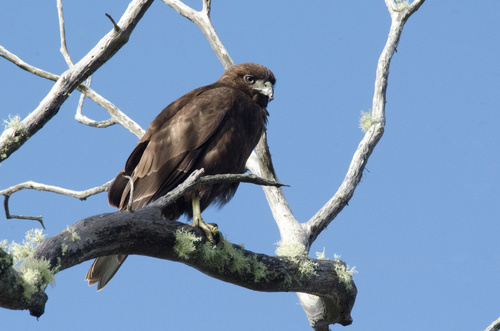
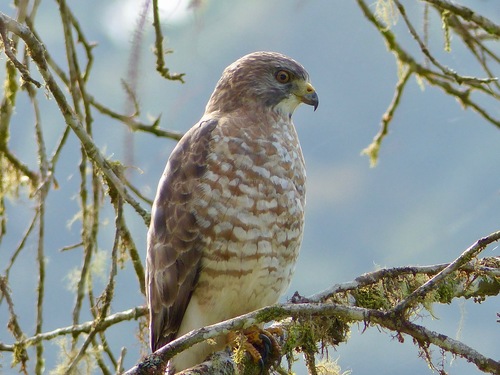
The broad-winged hawk, scientific name Buteo platypterus (Vieillot, 1823), is a relatively small Buteo species. It measures 32 to 44 cm (13 to 17 in) in total body length, and weighs between 265 and 560 g (9.3 to 19.8 oz). Its tail is relatively short, at 14.5–19.0 cm (5.7–7.5 in) long, while its tarsus measures 5.6 to 6.6 cm (2.2 to 2.6 in). Like most raptors, female broad-winged hawks are slightly larger than males. The species has distinctive relatively short, broad wings that taper to a pointed end, a tapered appearance unique to Buteo platypterus. Its wingspan ranges from 74 to 100 cm (29 to 39 in), and the standard measurement of the extended wing bone is 22.7–30 cm (8.9–11.8 in). Adult broad-winged hawks have dark brown upper bodies, with white bellies and chest marked with horizontal barring. Their tails are dark grey-black, with white lines along the base, middle, and tip. Juvenile hawks have different coloration, with more white and longitudinal barring instead of horizontal barring. Two color morphs exist: a dark morph with fewer white areas, and a paler overall light morph. Light morph individuals are most likely to be confused with red-shouldered hawks, which can usually be distinguished by their longer, more heavily barred tails and solid rufous adult wing color. Rare dark morph broad-winged hawks are dark brown on both upperparts and underparts. While they are similar to dark-morph short-tailed hawks, dark-morph short-tailed hawks have whitish under-tails with a single subterminal band. Broad-winged hawks have a wide distribution across North America and South America, ranging from southern Canada to southern Brazil. Their breeding range covers the northern and eastern parts of North America, and most migratory populations winter in Florida, southern Mexico, and northern South America. Five subspecies are endemic to the Caribbean and do not migrate. Migratory subspecies travel in flocks that can number from more than 40 up to several thousand individuals, flying at heights of 550 to 1,300 m (1,800 to 4,270 ft). They soar using thermals to complete a total migration journey of 3,000–6,000 km (1,900–3,700 mi). Fall migration lasts 70 days, with birds traveling approximately 100 km (62 mi) per day, moving from North America through Central America to South America without crossing salt water. The large migrating flocks of soaring broad-winged hawks are called kettles, and they form characteristic hawk migration spectacles at well-known sites in North America, including Hawk Cliff in Ontario, Hawk Ridge in Minnesota, Hawk Mountain in Pennsylvania, and the River of Raptors in Veracruz. Broad-winged hawks occur in areas up to around 2,000 m (6,600 ft) in elevation. They breed in deciduous forests that provide good nesting habitat, and forage primarily in wetlands and meadows. While some individuals have acclimatized to living near humans, even these birds avoid human settlements and interactions. Migrating subspecies select similar habitat conditions for winter, settling in deciduous and mixed forests. Although the species is declining in some areas due to forest fragmentation, its overall population numbers are relatively stable, and it is assessed as Least Concern on the IUCN Red List. Broad-winged hawks have only one mate per breeding season, possibly because males contribute a small amount of assistance to rearing chicks. They breed between April and August, after reaching sexual maturity at around two years old. Males perform a courtship display flight to attract females that includes cartwheeling, dives, and other aerial acrobatics. Mating pairs meet in the air, hook their feet together, and spiral downward together. Males also compete and fight with one another for the opportunity to mate with a female. If a male successfully mates, the pair produces only one brood per breeding season, containing 1 to 4 eggs. Both the male and female build the nest from sticks and twigs in a deciduous tree. After laying, the brown-spotted eggs are typically 49 mm × 39 mm (1.9 in × 1.5 in) and weigh around 42 g (1.5 oz). The female develops a brood patch and incubates the eggs for 28 days or longer before hatching. Hatchlings are semialtricial: they lack complex coordination, but have open eyes and are covered in down feathers. Chicks grow rapidly until they reach almost full adult body size, at which point they can walk, fly, and feed without parental help. While the chicks are in the nest, the female provides most parental care, protecting the chicks and bringing them food. The male may occasionally bring food to the female and offspring, but his visits are brief. When the female brings prey back to the nest, she tears off pieces to feed the chicks until the chicks are able to rip meat off on their own. Chicks often fight over offered food, with younger chicks usually losing fights and getting less food. Broad-winged hawks defend their nests by acting aggressively toward any suspected threat, diving and chasing intruders, though they generally do not make physical contact. Predators of broad-winged hawk eggs and nestlings include raccoons, crows, porcupines, and American black bears. Adult broad-winged hawks are preyed on by red-tailed hawks, great horned owls, bald eagles, and golden eagles. In Puerto Rico, invasive boa constrictors of some growth stages may eat broad-winged hawks. Hatchlings fledge (leave the nest) 5 to 6 weeks after hatching. Some young birds remain in the nest area for several additional weeks even after fledging.