About Buteo lineatus (Gmelin, 1788)
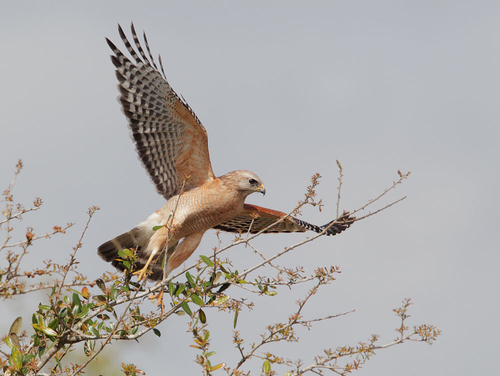
This species, the red-shouldered hawk, has the scientific name Buteo lineatus (Gmelin, 1788). Males measure 38 to 58 cm (15 to 23 in) in length and have an average weight of 550 g (1.21 lb). Females are slightly larger, with a length of 47 to 61 cm (19 to 24 in) and an average weight of 700 g (1.5 lb). The wingspan ranges from 90 to 127 cm (35 to 50 in), and adult body mass can vary between 460 to 930 g (1.01 to 2.05 lb). Among standard body measurements, the wing bone is 28–35 cm (11–14 in) long, the tail is 16–24 cm (6.3–9.4 in) long, and the tarsus is 7.5–9 cm (3.0–3.5 in) long. Adult red-shouldered hawks have brownish heads, reddish chests, and pale bellies marked with reddish bars. Their tails are quite long compared to other Buteo species, and are marked with narrow white bars. Red "shoulders" are visible when the birds are perched. The upper parts of these hawks are dark with pale spots, and they have long yellow legs. Populations in the western part of the species' range may appear more red, while populations in Florida are generally paler. The upper side of adult wings has more heavy barring. Juvenile red-shouldered hawks are often confused with juvenile broad-winged hawks, but can be told apart by their longer tails, crescent-shaped wing markings, and a more flapping, Accipiter-like flight style. When compared directly, red-shouldered hawks are typically larger and more proportionately long than broad-winged hawks, but are slightly smaller and more slender than most other common North American Buteo species. This species is also sometimes confused with the widespread red-tailed hawk. Red-tailed hawks are larger and bulkier, with more evenly sized, broad wings, paler underparts, and often have a noticeably reddish tail. Red-tailed hawks also more often soar steadily, holding their wings in a slight dihedral. One eastern population of red-shouldered hawks ranges west through southern Canada, from southern New Brunswick and Ontario to the eastern edge of the U.S. Great Plains, and south to Florida, the Gulf Coast, and eastern Mexico. Only the northernmost populations of this species are migratory. A western population breeds west of the Sierra Nevada from northern California to northern Baja California, and has recently expanded into Oregon and Arizona, as well as into areas east of the Sierra Nevada in California and southern Nevada. Eastern populations winter from southern Wisconsin, Oklahoma, Ohio, and southern New England south to the Gulf Coast, and are occasionally found throughout their entire breeding range during winter. In winter, they have been recorded as far south as Jalisco and Veracruz, Mexico. Western populations are mostly nonmigratory. Across its entire winter range, this species avoids higher elevations. Eastern birds occasionally wander west during migration, with records from places including Colorado, Kansas, West Texas, Manitoba, and North Dakota; western birds have strayed east to Arizona, Nevada, Idaho, and Utah, and north to Washington. In the eastern part of the range, individuals from the northern half of the species' range are migratory. In the west, most populations are year-round residents. Red-shouldered hawks are short- to moderate-distance migrants, with most individuals traveling between 300 and 1,500 km each way. The species follows leading geographic lines, migrating along inland ridges and coastlines. Larger numbers of red-shouldered hawks are counted at coastal migration watch sites than at inland sites. Juveniles often migrate before adults in autumn, while adults migrate before juveniles in spring. Red-shouldered hawks typically migrate alone, though they sometimes form small flocks of three or more birds. The species usually avoids crossing large bodies of water. While migrating, red-shouldered hawks use a mix of soaring, gliding, and flapping flight. A study of red-shouldered hawk home range and habitat use in southern California found an average home range of 1.2 square kilometres (0.46 sq mi), and showed that the species has moderate adaptability to human-altered landscapes. This adaptability is important because 98% of riparian forest habitat in California's Central Valley was lost between 1850 and 1977. Red-shouldered hawks are forest raptors. In the east, they live in bottomland hardwood stands, flooded deciduous swamps, and upland mixed deciduous–conifer forests. They tend to occupy stands with an open subcanopy, which makes hunting easier. They are not restricted to deep forest, however; they can also be found in some suburban areas where buildings are mixed into woodlands. In the west, they live in riparian and oak woodlands, and also occur in eucalyptus groves and some residential areas. Red-shouldered hawks search for prey while perched on a treetop or soaring over woodlands. When they spot prey, they kill it by dropping directly onto it from the air. They may store food near their nest to eat later. When in clearings, they sometimes fly high then drop down to surprise prey. Like most raptors, red-shouldered hawks have very good vision and reasonably good hearing, and their talons are strong enough to kill animals as large as they are. Small mammals, especially rodents, are typically the most common prey. Voles, gophers, mice, moles, and chipmunks may be favored locally depending on how abundant they are. Slightly larger mammals, such as rabbits and tree squirrels, are also occasionally preyed on. Other prey includes amphibians, reptiles (especially small snakes), birds, fish, and large insects. They will attack birds up to the size of a ruffed grouse or ring-necked pheasant. Steller's jays and blue jays, both potential prey species for red-shouldered hawks, sometimes regularly imitate the red-shouldered hawk's call, and are known to be hard to tell apart from the hawk by voice alone. During winter, red-shouldered hawks sometimes become accustomed to preying on birds commonly found at bird feeders. In some areas where the species is common, crayfish can be an important prey source. Unusual food items recorded for this species include nocturnal animals such as eastern screech owls and flying squirrels, and road-killed deer.