About Buteo lagopus (Pontoppidan, 1763)
This is a fairly large raptor species. It measures 46–68 cm (18–27 in) in length, with a wingspan ranging from 120 to 153 cm (47 to 60 in). Individual body weight ranges from 600 to 1,660 g (1.32 to 3.66 lb), and females are typically larger and heavier than males. Adult weights increase from summer to winter, with average weights shifting from 822 g (1.812 lb) to 1,027 g (2.264 lb) in males, and from 1,080 g (2.381 lb) to 1,278 g (2.818 lb) in females. Among members of the genus Buteo, this species ranks sixth in weight, fifth in length, and fourth in wing length. Standard measurements for adults are as follows: wing chord 37.2–48.3 cm (14.6–19.0 in), tail 18.6–25.5 cm (7.3–10.0 in), culmen 3.2–4.5 cm (1.3–1.8 in), and tarsus 5.8–7.8 cm (2.3–3.1 in).
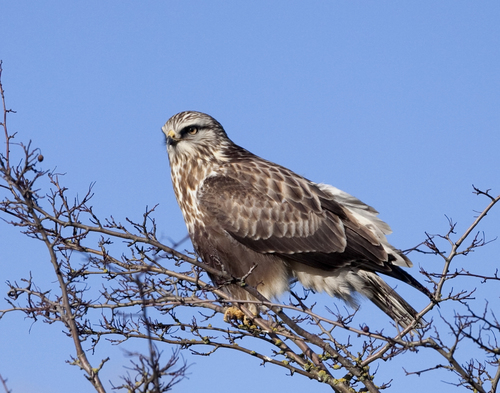
Plumage is predominantly brown and white, and often has a high degree of speckling. Most plumages have a broad brown chest-band, and a square dark carpal patch that contrasts with the white under-wing is an easily identifiable characteristic in light morph individuals. A wide range of plumage patterns occur across light and dark morphs, males and females, and adults and juveniles. Extensive field experience is needed to tell certain plumage variations apart. It is slightly larger than its more common Palearctic cousin the common buzzard (Buteo buteo) and its Nearctic cousin the red-tailed hawk (Buteo jamaicensis), though the red-tailed hawk may outweigh it.
As an adaptation to the cold of its Arctic home range, its legs are feathered, while its toes are not. This feature is reflected in its scientific name, where lagopus means "hare-foot". Its talons are relatively small, which matches its preferred prey. Distinguishing characteristics that appear in all plumages include long white tail feathers with one or more dark subterminal bands. When perched, the wing tips are long enough to reach or extend past the end of the tail.
The common buzzard can look similar, with a comparable long-tailed shape and notoriously variable plumage; the rough-legged buzzard is longer-winged and has a more eagle-like appearance. The red-tailed hawk has a chunkier build, a darker head, broader shorter wings, barring on the wings and tail, a dark leading edge to the wings (rather than a black wrist patch), and lacks a white base to the tail. The ferruginous hawk is larger, has a bigger, more prominent bill, a whitish comma marking at the wrist, and an all-pale tail. It is the only raptor of its size, other than the distinctly different osprey, that regularly hovers over one spot by beating its wings quickly.
The rough-legged buzzard breeds in tundra and taiga habitats of North America and Eurasia, between the latitudes of 61° N and 76° N, and occurs locally as far south as 48° N in Newfoundland and 58° N in southern Norway. North American populations migrate to southern Canada and the central United States for the winter, while Eurasian populations migrate to central Europe and Asia, with small numbers traveling west to eastern parts of Great Britain. Most wintering individuals occur between latitudes of 43° and 58° N. It is the only member of its diverse genus found on all three northern continents, with a complete circumpolar distribution. In the winter months from October to April, preferred habitats include marshes, moorland, prairies, and agricultural regions where rodent prey is most abundant. Breeding sites are usually located in areas with extensive unforested, open ground.
Migrants arrive at breeding grounds during April and May, depending on snow conditions. Winter home ranges commonly measure 10–15 km2 (3.9–5.8 sq mi), varying with food supply, but little is known about breeding season home ranges. Although it is frequently attacked in skirmishes by other highly territorial birds such as gyrfalcons and skuas, the rough-legged buzzard is not strongly territorial. However, wintering rough-legged buzzards may behave aggressively toward common buzzards in Sweden, and both species will attempt to exclude the other from a fixed hunting range.
Sexual maturity is reached at approximately two years old. Breeding generally takes place in May, but timing varies based on arrival dates at breeding grounds. The rough-legged buzzard is thought to be monogamous, with pairs mating for multiple years, and no current evidence contradicts this. Unlike most migratory birds, which search for suitable nesting territory in spring, rough-legged buzzards scout for territory in advance, in autumn. After the breeding season, they make long-distance prospecting flights to find suitable habitat with high rodent populations, then return to that site the following year. Nests are built shortly after arrival at breeding grounds and take 3–4 weeks to complete. They are constructed from twigs, sedges, and old feathers, with a diameter of 60–90 cm (24–35 in) and a height of 25–60 cm (9.8–23.6 in). Cliff ledges and rocky outcroppings are the preferred nesting sites.
Females can lay 1–7 eggs, but typically lay 3–5. The average egg size is 56.4 mm (2.22 in) in length by 44.7 mm (1.76 in) in width. The minimum incubation period is 31 days, and incubation is provided almost exclusively by the female. The male feeds the female during the incubation period. After hatching, young birds take 4–6 weeks to fledge from the nest. Fledglings depend on their parents to provide food for 2–4 weeks after leaving the nest. Rough-legged buzzards may nest in association with peregrine falcons (Falco peregrinus); peregrines chase small rodent predators away from their nesting territory, and rough-legged buzzards may use these areas as nesting territory.