About Buteo jamaicensis (Gmelin, 1788)
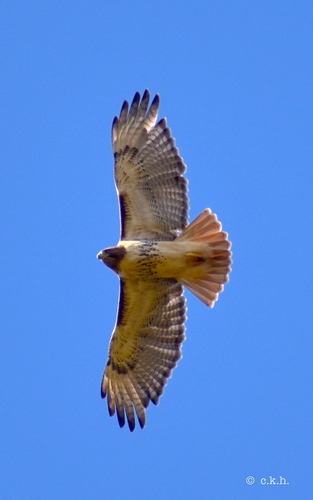
The red-tailed hawk (Buteo jamaicensis, first described by Gmelin in 1788) displays sexual size dimorphism, with females growing up to 25% larger than males. Like many large raptors, commonly cited average body masses for the species are somewhat higher than what extensive research has found. Body mass varies strongly with season and clinal variation: male weights generally range from 690 to 1,300 g (1.52 to 2.87 lb), while females range from 900 to 2,000 g (2.0 to 4.4 lb). Combined data from nine migration site studies in the United States and two breeding studies (one on the smallest subspecies in Puerto Rico, another on larger subspecies in Wisconsin) gives an average male mass of 837 g (1.845 lb) and an average female mass of 1,040.7 g (2.294 lb), which is roughly 15% lighter than previously published species-wide weights. The highest average recorded weights came from migrating hawks at Cape May, New Jersey, where females averaged 1,278 g (2.818 lb) and males averaged 990.8 g (2.184 lb). The lowest average weights came from the Puerto Rican breeding population in forest openings, where females averaged 1,023 g (2.255 lb) and males averaged 795 g (1.753 lb); this population also has the highest degree of sexual size dimorphism in the species. Body mass variation in red-tailed hawks is typically modest: the average mass of the heaviest subspecies is only just over 18% heavier than the lightest, making mass variation half as variable as that of great horned owls, where the heaviest subspecies is on average about 36% heavier than the lightest. Reported total length ranges from 45 to 60 cm (18 to 24 in) for males and 48 to 65 cm (19 to 26 in) for females. Wingspan ranges from 105 to 141 cm (41 to 56 in), and following standard scientific measurement methods, wing chord length is 325.1–444.5 mm (12.80–17.50 in). Tail length measures 188 to 258.7 mm (7.40 to 10.19 in). The middle toe, measured excluding the talon, ranges from 38.3 to 53.8 mm (1.51 to 2.12 in), while the hallux-claw (the rear toe talon, which is the largest in accipitrids) measures 24.1 to 33.6 mm (0.95 to 1.32 in) in length. Red-tailed hawk plumage varies by subspecies and region, forming distinct color morphs that are not associated with molting. The western North American subspecies B. j. calurus is the most variable, with three main color morphs: light, dark, and intermediate or rufous. Dark and intermediate morphs make up 10–20% of this subspecies' population. While markings and coloration differ across subspecies, the red-tailed hawk's general appearance is consistent. The species has a blocky, broad body shape and is often heavier than other Buteo species of similar length. Most color morphs have a whitish underbelly crossed by a dark brown belly band formed from horizontal feather streaks. Younger birds especially may have dark brown spotting covering other areas of the underside. The species gets its common name from its red tail, which is uniformly brick-red on the upper surface and light buff-orange on the underside. The bill is short, dark, and hooked, as is typical for raptors, and the head can appear small relative to the thick body. Red-tailed hawks have relatively short, broad tails and thick, chunky wings. Their cere, legs, and feet are all yellow. Adult red-tailed hawks are usually easy to identify by their red tail, which ends in a single black band. Immature birds are harder to identify, as their tails are patterned with around six darker bars. Flight shape is a useful identification clue, and at close range, their yellowish irises are distinctive. As the bird reaches full maturity over 3–4 years, the iris gradually darkens to a reddish-brown color. The red-tailed hawk is one of the most common and most widely distributed hawks in the Americas. Its breeding range extends from central Alaska, the Yukon, and the Northwest Territories east to southern Quebec and the Maritime Provinces of Canada, and south to Florida, the West Indies, and Central America. In winter, its range stretches from southern Canada south through the rest of the breeding range. Its preferred habitat is a mix of forest and open fields, with high bluffs or trees that can be used as perches. It occupies a wide variety of habitats and altitudes, including deserts, grasslands, coastal regions, mountains, foothills, coniferous woodlands, deciduous woodlands, tropical rainforests, agricultural fields, and urban areas. In North America, it is second only to the peregrine falcon in the diversity of habitats it uses. It lives across nearly the entire North American continent, only absent from areas of unbroken forest and the high Arctic. Adult red-tailed hawks have few natural predators, but a variety of organisms prey on their eggs and chicks. The species is widespread across North America in part because historical human settlement patterns have benefited it. Forest clearing in the Northeast created new hunting areas, while preserved woodlots provided viable nesting sites. Over the past century, increased tree coverage across the Great Plains from fire suppression and tree planting helped the red-tailed hawk expand its range westward, alongside many other bird species. Highway construction that added utility poles next to treeless medians created ideal perch-hunting habitat. Unlike some other raptors, red-tailed hawks are seemingly unbothered by significant human activity and can nest and live close to large human populations. As a result, the species also occurs in cities, where common prey such as rock pigeons and brown rats can support their populations. One well-known urban red-tailed hawk named "Pale Male" became the subject of the non-fiction book Red-Tails in Love: A Wildlife Drama in Central Park, and is the first red-tailed hawk known in decades to successfully nest and raise young in the crowded New York City borough of Manhattan. Because red-tailed hawks have relatively specialized feeding habits, they host fewer helminth parasitic worms than species with broader diets like the broad-winged hawk. Red-tailed hawks living in urban areas are threatened by rat traps and poisoned bait used to control rodents. These poisons are typically warfarin-treated bait that causes internal bleeding in rats and mice, and any hawk that eats an affected rodent will also be poisoned. Red-tailed hawks reach sexual maturity at two years of age. They are monogamous, mating with the same individual for many years, and generally only take a new mate if their original mate dies. A mated pair may defend the same nesting territory for multiple years. During courtship, the male and female fly in wide circles while making shrill cries. The male performs aerial displays, diving steeply then climbing back up. After repeating this display several times, he sometimes briefly grasps the female's talons with his own. Courtship flights can last 10 minutes or longer. Copulation often follows courtship flights, though it also frequently occurs without prior courtship flight. For copulation, a perched female tilts forward to let the male land on her back with his feet placed on her horizontal back. The female twists and moves her tail feathers to one side, while the mounted male positions his cloacal opening against the female's cloaca. Copulation lasts 5 to 10 seconds, and can occur multiple times per day during pre-nesting courtship in late winter or early spring. During the same pre-nesting period, the pair builds a stick nest. Nests are most often placed in a large tree 4 to 21 m (13 to 69 ft) off the ground, or on a cliff ledge 35 m (115 ft) or higher above ground, and they may also be built on man-made structures. The nest is generally 71 to 97 cm (28 to 38 in) in diameter and can grow up to 90 cm (3.0 ft) tall. It is built from twigs, and lined with bark, pine needles, corn cobs, husks, stalks, aspen catkins, or other soft plant material. Great horned owls compete with red-tailed hawks for nest sites. Both species have been recorded killing the other's young and destroying eggs, but in general they nest in adjacent or overlapping territories without open conflict. Great horned owls cannot build their own nests, so they usually take over existing red-tailed hawk nests. They also begin nesting much earlier than red-tailed hawks, often as early as December. Because of this, red-tailed hawks have adapted to build new nests when their previous year's nest has been taken over by owls or is otherwise lost. New nests are typically built within 1 kilometer or less of the previous nest, and often within just a few hundred meters. As a large predator, red-tailed hawks mostly only face predation on their eggs and nestlings, which are taken by owls, corvids, and raccoons. A clutch of one to five eggs is laid in spring, with one egg laid roughly every two days. Both parents incubate the eggs. Altricial nestlings hatch over a period of 2 to 4 days. The female broods the nestlings while the male provides most of the food for the female. The female tears the food into small pieces to feed the young. After 42 to 46 days, the young begin to leave the nest. Fledging, which includes learning to fly and hunt, takes around 10 weeks. About 6 to 7 weeks after fledging, young red-tailed hawks start capturing their own prey. The red-tailed hawk is a popular bird in falconry, particularly in the United States where falconry is tightly regulated. In the U.S., red-tailed hawks are widely available and permitted for use by novice falconers. They are highly tameable and trainable, with a more social temperament than all other falcons or hawks except the Harris's hawk. They are also long-lived and highly resistant to disease, so falconers can keep a red-tailed hawk as a hunting companion for many years. There are fewer than 5,000 falconers in the United States, so despite their popularity in the sport, any impact on the United States red-tailed hawk population, estimated at around one million individuals, is negligible. Red-tailed hawks are not as swift as falcons or accipiters, so they are not the most effective bird-hunting raptors, and are usually used to hunt ground game such as rabbits and squirrels. However, some individual red-tailed hawks learn to ambush birds on the ground with a sudden surprise approach, capturing them before they can reach full speed and escape. A few have even learned to use a falcon-like diving stoop to catch challenging game such as pheasants. During a typical hunt, a falconer using a red-tailed hawk most often releases the hawk and lets it perch on a tree or other high vantage point. The falconer, sometimes assisted by a dog, then flushes prey by disturbing ground cover. A well-trained red-tailed hawk will follow the falconer and dog, recognizing that their activities create opportunities to catch game. After catching prey, the hawk does not return it to the falconer; instead, the falconer must locate the hawk and its captured prey, carefully approach (called "making in"), and trade the hawk a piece of offered meat in exchange for the kill. For many Indigenous American peoples, the feathers and other body parts of the red-tailed hawk are considered sacred. Like the feathers of the bald eagle and golden eagle, red-tailed hawk feathers and parts are sometimes used in religious ceremonies and decorate the regalia of many Native Americans in the United States. These parts, especially the distinctive tail feathers, are a popular item in Native American communities. As with bald and golden eagles, possession of red-tailed hawk feathers and parts is regulated by the eagle feather law, which governs ownership of feathers and body parts from migratory birds.