About Buteo hemilasius Temminck & Schlegel, 1844
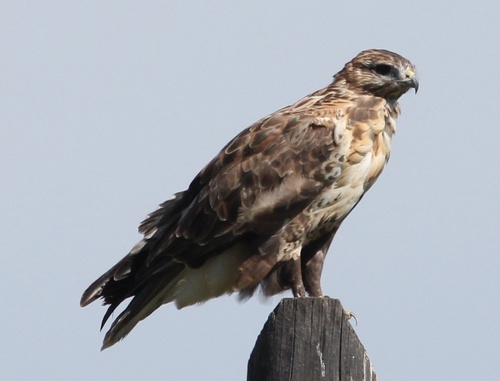
Upland buzzard (Buteo hemilasius Temminck & Schlegel, 1844) is the largest buzzard and the largest member of the genus Buteo in the world based on total length and wingspan. However, it is roughly equal in bulk to the North American ferruginous hawk (Buteo regalis), which is only marginally smaller when measured by mean standard measurements. The total length of the upland buzzard is 57 to 72 cm (22 to 28 in) and its wingspan is 143 to 161 cm (4 ft 8 in to 5 ft 3 in). Known body mass ranges from 950 to 1,400 g (2.09 to 3.09 lb) in males (three individuals averaged 1,168 g / 2.575 lb), and from 970 to 2,050 g (2.14 to 4.52 lb) in females (seven individuals averaged 1,581 g / 3.486 lb). The average measurements of 14 upland buzzards from the Tibetan Plateau were 639 mm (25.2 in) in total length, including a 289 mm (11.4 in) tail, a small 30 mm (1.2 in) culmen, an 86 mm (3.4 in) tarsus, and an average body mass of 1,557 g (3.433 lb). The upland buzzard is conspicuously large for a Buteo, with long wings and a relatively long tail, and is fairly eagle-like compared to related species. It has both pale and dark morphs. The pale morph is generally beige and earthen dark brown. This morph has a lightly marked whitish head and nape with a variable ochre wash, and the chest is usually purest whitish. On pale morphs, the whitish chest contrasts with dark brown areas that are widely but irregularly distributed across the lower breast and abdomen. The flanks and belly are similarly dark, while the tail is greyish with dark sides and prominent dark bands, including a heavier sub-terminal band. The coverts of perched buzzards often appear lighter brown than other parts of the body. In flight, pale morphs have variably colored major coverts that appear somewhat streaky brown, contrasted with a very strong blackish patagium mark. The flight feathers are whitish with a variable amount of dark barring leading into the blackish wingtips and trailing edges. Dark morph upland buzzards are almost entirely solid black-brown across their entire body. Their flight feather pattern is similar to that of pale morphs, but the rest of the body is darker. The leg "trousers" are heavily feathered brown, often covering at least three-quarters of the legs. Despite individual variations, these buzzards have more leg insulation than other Buteo, except for the ferruginous hawk and rough-legged buzzards (B. lagopus), which both have feathering extending along their tarsi. The call of the upland buzzard is a prolonged nasal mewing, not dissimilar to that of the common buzzard (B. buteo), although it is said to vocalize less than that species. The upland buzzard is fairly similar in plumage to other buzzards, and may need to be distinguished from overlapping species including the long-legged buzzard (B. rufinus), Himalayan buzzard (B. reflectus) and eastern buzzard (B. japonicus). The Himalayan species in particular often shares a similar distribution and similar high-elevation habitats. The upland buzzard is known to be difficult to distinguish from the related long-legged buzzard, and the two species are often misidentified for each other. However, it can be told from the long-legged buzzard by being slightly larger and lacking that species' warmer, sometimes rufous (rather than earthen brown) tones. The extent of patterns is roughly similar in both the upland and long-legged buzzard, and their proportions and size broadly overlap between the two. Usually the long-legged buzzard tends to occur at lower elevations. However, distant flying buzzards of these two species are sometimes considered too similar to be reliably identified, especially darker individuals. The other compared buzzard species are conspicuously smaller, with much smaller wings and shorter tails that have shorter overall proportions. Both Himalayan and eastern buzzards are also differently marked, usually appearing paler on the belly (apart from a belly band and stippling to the flanks) and have less strongly contrasting patterns on the wing coverts and flight feathers. Dark morphs of these respective species are more similarly marked, but the upland buzzard can still be distinguished by its size and proportions, except for dark morph long-legged buzzards, which are practically indistinguishable. The great majority of the upland buzzard's breeding range is centered in Mongolia and China; within China, it breeds especially in the western, northern and northeastern areas. North of Mongolia (where it occurs throughout the country), upland buzzards also breed in several adjacent areas of southern Siberia. To the west, their breeding range may extend just slightly into far eastern Tajikistan, southeastern Kyrgyzstan, and more recently into East Kazakhstan Region, where they were first documented nesting in 1990. To the south, the upland buzzard may breed in the far northern reaches of Bhutan and Nepal, and was first recorded nesting in the Indian subcontinent in 1998, within Changtang, Tibet. During migration passage, northern birds spread through non-breeding areas of western China, eastern Kyrgyzstan, and far to the east in North Korea and South Korea. Wintering areas of upland buzzards include much of eastern Kazakhstan, northern India, most of Nepal and Bhutan, and central and eastern China. Generally, upland buzzards are not long-distance migrants, and many travel only minimal distances to reach wintering grounds. In rare cases, upland buzzards have appeared in Japan as well, most likely as vagrants from Korea. There is an old unconfirmed claim of an upland buzzard appearing in Iran during winter. This species tends to be generally uncommon, but it can range from abundant (in areas like Tibet and peak prey habitats in Mongolia) down to rare across parts of its range. The upland buzzard is not considered a threatened species. The upland buzzard is normally found in open, high elevation regions. While it has been recorded at over 5,000 m (16,000 ft) in elevation, the species normally nests at elevations between 1,000 and 4,500 m (3,300 and 14,800 ft), and may sometimes be recorded down to sea-level during the winter. In montane areas, it nests in habitats such as alpine meadow, upland steppe and plateaus, and usually forages in these grasslands and rocky areas. They also visit cultivated areas such as arable lands in both summer and winter. The upland buzzard is a fairly typical Buteo that often engages in extensive soaring flights, holding its wings in a quite strong dihedral. The upland buzzard frequently hovers, often during hunting. Unlike many Buteos, perches are not usually available to them while hunting, so they must swoop down from active flight, though they may sometimes make use of rocks as hunting perches. They will also sometimes capture insects on the ground. The upland buzzard is a partial migrant, often traveling minimal distances in an apparent search of appropriate hunting areas. Migration occurs in September to October in autumn, and birds return to breeding grounds in spring from March to May. The species is frequently recorded migrating over the Gobi Desert in late October. Wintering areas (from vagrants in Japan to southern China) can include lowland cultivation. Upland buzzards often feed extensively on the same prey and in the same habitats as Eurasian eagle-owls (Bubo bubo); however, the eagle-owl is considerably larger and more powerful, and sometimes additionally hunts upland buzzards. Additionally, upland buzzards have been known to fall victim to golden eagles (Aquila chrysaetos). The upland buzzard breeds between April and August, with egg laying usually occurring in May. Nests are usually located on outcrops, crags and ledges of cliffs, typically in locations sheltered from the elements by rocks or vegetation. Some nests are also placed on steep rocky slopes. The nest is constructed with sticks and well lined, often with wool, grass, dry dung, and (potentially harmfully) human garbage. This species normally lays a clutch of 2 to 4 eggs, and is capable of laying a replacement clutch if an entire clutch is lost. In Mongolia, clutch sizes have been recorded exceptionally varying up to 8, with an average reported clutch size of 3.49. Incubation lasts 36 to 38 days, though it was previously reported to only last about 30 days. The chicks have greyish-brown down and develop fairly slowly, fledging at around 45 days. In western and central Mongolia, average brood size was 1.95. Commonly, two young fledge from an upland buzzard nest, though up to four fledglings have been recorded. Breeding success is known to be food-dependent, and higher sibling competition (and perhaps siblicide) have been reported when populations of stable prey such as voles decline.