About Buteo galapagoensis (Gould, 1837)
The scientific name of the Galápagos hawk is Buteo galapagoensis (Gould, 1837). In size, the Galápagos hawk is similar to the North American red-tailed hawk (Buteo jamaicensis) and Swainson's hawk (Buteo swainsoni). Like many Galápagos native animals, its size varies across the archipelago's different islands. It is somewhat more heavily built than these mainland species, and by average weight, it is the second heaviest Buteo in the Americas, with only the ferruginous hawk being heavier. The Galápagos hawk measures 45 to 58 cm (18 to 23 in) from beak to tail, with a wingspan ranging from 116 to 140 cm (46 to 55 in).
The smallest recorded Galápagos hawks live on Marchena Island, where males average 844 g (1.861 lb) and females average 1,223 g (2.696 lb). Hawks on Santiago Island are intermediate in size: males average 963 g (2.123 lb) and females average 1,295 g (2.855 lb). The largest known populations are on Española Island, whose individuals rank among the largest known Buteo anywhere: males average 1,137 g (2.507 lb) and females average 1,578 g (3.479 lb). As with many birds of prey, males are smaller than females.
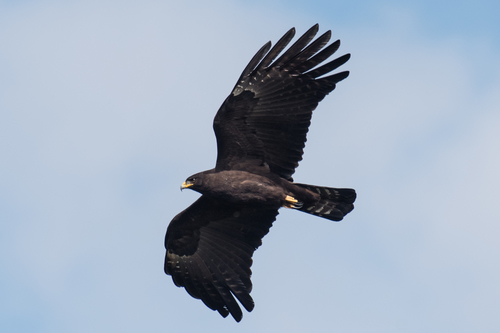
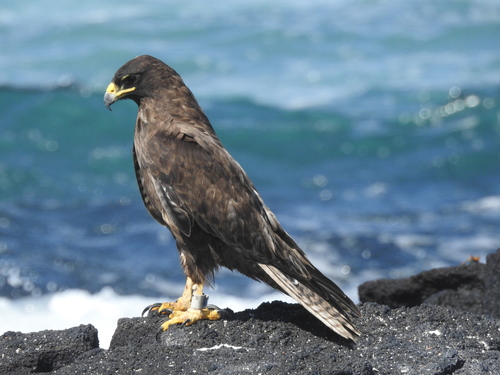
Adult Galápagos hawks show some variation in coloring across the species. Most adults are generally a sooty brownish-black, with a slightly blacker crown than the back. Mantle feathers are partially edged with paler brown, grey, or buff, and their white bases are visible to some degree. Tail coverts are barred with white. The upper side of the tail is silvery grey with around ten narrow black bars, while the underside of the tail is quite pale. Wing feathers are paler on their inner webs and barred with white. On the underbody, the flank and lower abdomen feathers have indistinct rufous edges. Under-tail coverts are barred with white. Under-wing coverts are black, contrasting with the pale bases of the wing quills. Adults have brown eyes, a greyish-black beak that is paler at the cere (the base of the beak), and yellow legs and feet.
Young Galápagos hawks look quite different from adults. They are well camouflaged, with an overall brown base color, varying amounts of striping on the underbody, and paler mottling on the upper body. Juveniles have light grey-brown eyes, a black beak that is blue-grey at the base, a grey-green cere, and pale yellow-green feet. When immature plumage becomes heavily worn, the pale areas turn almost white. The differing camouflaged plumage of young hawks helps protect them from potential predators until they are fully grown.
The Galápagos hawk has broad wings and a broad tail. It is an apex predator with excellent vision.
The Galápagos hawk's habitat supports a varied diet. It primarily hunts insects including locusts and giant centipedes, along with racer snakes (Alsophis spp.), lava lizards (Microlophus albemarlensis), and both native and introduced rodent species: Galápagos rice rats (Aegialomys galapagoensis), house mice (Mus musculus), and black rats (Rattus rattus). It frequently preys on marine iguanas (Amblyrhynchus cristatus), mostly targeting hatchlings and juveniles, though it occasionally takes adults, especially nesting females. The Galápagos hawk can kill relatively large marine iguana individuals that weigh at least as much as the hawk itself, or even more. It also takes hatchlings of tortoises, sea turtles, and land iguanas, as well as young Galápagos sea lions, feral pigs, and goats. Arboreal prey includes Galapagos Doves (Zenaida galapagoensis), Galapagos Mockingbirds (Mimus parvulus), and Darwin's finches (Geospiza spp. & Camarhynchus spp.), ranging from eggs to full-grown adults. It has also been recorded preying on seabirds such as Galapagos Shearwaters (Puffinus subalaris), plus eggs and nestlings of swallow-tailed gulls (Creagrus furcatus). Regular predation on blue-footed booby (Sula nebouxii) nestlings, which weigh around 1280g, has been reported. In addition to live prey, the Galápagos hawk also feeds on carrion, including dead seals and fish scraps.
Galápagos hawks hunt in groups of two or three, soaring at heights between 50 and 200 m (160 to 660 ft). When one hawk spots prey or a rotting carcass, it signals the other group members. The dominant hawk in the group feeds first until it is full, while the other hawks in the family group wait submissively for their turn to feed. When hunting, the Galápagos hawk prefers to perch on lava outcrops or high branches, but it also spends time on the ground. Galápagos hawks are not afraid of humans; young hawks are especially curious, and often wander around human camps to scavenge for food scraps. In 1845, Charles Darwin wrote: "A gun is here almost superfluous; for with the muzzle I pushed a hawk out of the branch of a tree..."