About Buteo augur (Ruppell, 1836)
The augur buzzard, Buteo augur, is one of two larger Buteo species native to Africa, alongside the similarly sized jackal buzzard. Adults measure 48 to 60 cm (19 to 24 in) in length, with a wingspan of 120 to 150 cm (3 ft 11 in to 4 ft 11 in). Males weigh 880 to 1,160 g (1.94 to 2.56 lb), while females weigh 1,100 to 1,330 g (2.43 to 2.93 lb). A small sample found 5 augur buzzards had an average weight of 973.2 g (2.146 lb), while 22 birds had an average wingspan of 131.5 cm (4 ft 4 in).
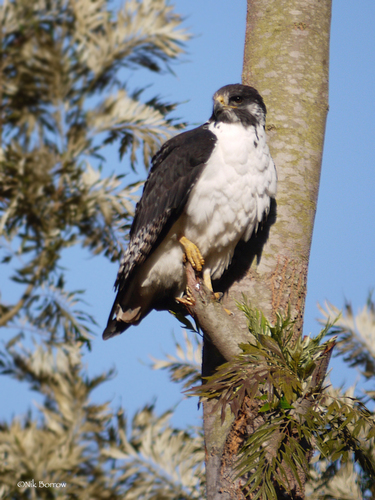
When seen clearly, adult augur buzzards have distinctive, striking plumage that makes them essentially unmistakeable. Their upperparts are almost black-brown, with a contrasting rufous tail that stands out sharply. Primary flight feathers are blackish, and secondary flight feathers are off-white; both are barred with black. The area below the chin and around the throat is mainly white, while the rest of the underparts and underwing coverts are rich rufous. From below, the flight feathers are white with black tips, forming a dark trailing edge on the wing. Some sources incorrectly note that adult augur buzzards have white underparts and underwings, with black on the female's lower throat.
Juvenile augur buzzards have mainly brown upperparts, and rufous brown underparts and tail. They can be confused with the steppe buzzard (Buteo buteo vulpinus), a migratory common buzzard subspecies that overwinters in East and southern Africa. However, augur buzzards are considerably larger and bulkier, with broader wings, a heavier flight style, and an unbarred undertail. Even though juvenile augurs are not as dark as adults on their back and upperwing coverts, they are usually noticeably darker than juvenile steppe buzzards. Juvenile augur buzzards are similar to juvenile jackal buzzards, but are generally much paler below, with bolder carpal patches and more clearly barred secondaries and tail.
A melanistic morph of the augur buzzard exists, which is entirely black except for barred black, grey and white flight feathers that contrast strongly with the black body, plus a chestnut tail. Around 10% of all augur buzzards are melanistic, but this proportion rises in high-rainfall forested areas, reaching up to 50% in some regions. A similar melanistic morph also occurs in jackal buzzards, and the two can be very hard to tell apart; the only consistent difference is the stronger barring on the pale flight feathers of melanistic augur buzzards. Dark morph long-legged buzzards may also be mistaken for melanistic augur buzzards, but long-legged buzzards have clearly more slender wings, are less blackish on the body, and lack the distinct rufous tail of the augur buzzard.
The augur buzzard is native to eastern and southwestern Africa. Despite its seemingly erratic distribution, it is often common within its range. Its distribution extends from eastern Sudan and Ethiopia (including northern Somalia, where the subspecies B. a. archeri occurs) down through the northeast of the Democratic Republic of the Congo, Uganda, Kenya, and parts of Tanzania, into Zambia, Malawi, Zimbabwe, Mozambique, western Angola, and west-central Namibia. Although it has a wide range across southern Africa, it only appears in South Africa as a vagrant.
Augur buzzards occupy open or lightly wooded upland areas, but can also range into lowland deserts at sea level (such as those in Namibia) and more mountainous, precipitous areas of eastern Africa. They seem to prefer hunting in elevated savanna grasslands, high open moorland, inland cliffs, and cropland, and sometimes occur in open forest or along desert edges. In east Africa, they usually live between 400 and 4,600 m (1,300 and 15,100 ft) elevation, most often above 1,500 m (4,900 ft), and have been recorded at 5,000 m (16,000 ft) in Ethiopia.