About Buteo albonotatus Kaup, 1847
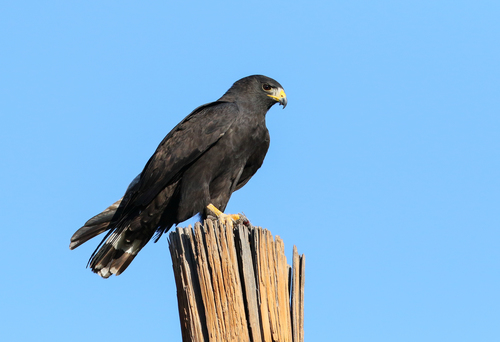
Buteo albonotatus, commonly called the zone-tailed hawk, is a fairly large but slender Buteo hawk. Adult birds measure 46 to 56 cm (18 to 22 in) in length, with a wingspan of approximately 117–140 cm (46–55 in). Its length and wingspan are comparable to common large northern Buteos such as Swainson's hawk and red-tailed hawk, but zone-tailed hawks generally weigh considerably less. Their body mass ranges from 565–1,080 g (1.246–2.381 lb). The sexes are close in most measurements, but females are much heavier and bulkier than males: females average 900 g (2.0 lb), while males average 637 g (1.404 lb). Among standard measurements, the wing chord is 36.5–46 cm (14.4–18.1 in), the fairly long tail is 19.4–23.5 cm (7.6–9.3 in), and the tarsus is 6.7–7.8 cm (2.6–3.1 in). Adult zone-tailed hawks have mostly blackish plumage. The main exception is that their flight feathers are barred with lighter gray, which can appear solid silver-gray when viewed from a distance. The tail has three or four light bands (the "zones" that give the species its common name): these bands are white when viewed from below and light gray from above, and the band second from the tip is particularly broad and conspicuous. The cere and legs are yellow, the lores are light gray, and a faint patch of white may be visible on the face. Immature zone-tailed hawks are similar to adults, except they have small white spots on the breast, tails with narrow gray and black bands, and a broad dark tip at the end of the tail. Adult zone-tailed hawks resemble common black hawks, but are distinctly more slender in flight and overall smaller, and have more white bars on the tail. Other dark-phase Buteo hawks, especially broad-winged hawks, may appear similar, but typically have more silvery coloration on the wings and broader wings. The zone-tailed hawk's call is a loud scream, a fairly typical Buteo call that drops in pitch at the end, transcribed as kra kree-kree-kree-kree. In at least some individuals, there is an abrupt rise in pitch in the middle of the call (similar to a shift to falsetto) followed by an equally abrupt drop back down. They most often vocalize when performing breeding displays at the start of the mating season. When disturbed at the nest, they may give a long, lower-pitched raaaaauu call. The breeding range of zone-tailed hawks extends from parts of southern Arizona, New Mexico, and western Texas through almost all of inland Mexico and the central portions of Central America, down to eastern Colombia and Ecuador; they occur more sporadically further south into Peru, southern Brazil, Paraguay, Bolivia, and northern Argentina. In winter, zone-tailed hawks generally withdraw from the United States and northernmost Mexico, and these populations mostly winter in Oaxaca and the Yucatán Peninsula. This species is also native to the Caribbean island of Trinidad. Central American populations may be seasonally migratory, though their movements are not well understood. Zone-tailed hawks sometimes wander outside their normal range, and one individual has been recorded in Nova Scotia. Across their broad range, zone-tailed hawks can adapt to a wide variety of habitats, including both closed and open environments, and both wet and dry areas. The largest populations are most often found in rocky areas with access to water. They frequently reside in coniferous or pine-oak forests, timbered canyonland, hilly riverine woods, dry open boscage and scrub, humid forests, and overgrown marshes. They may forage over ranches and even semi-desert, but always require at least scattered tree thickets for nesting. Their elevational distribution ranges from sea level up to 3,000 m (9,800 ft), though they are mainly found below 1,500 m (4,900 ft) in the northern part of their range and below 500 m (1,600 ft) in the southern reaches of their breeding range. The flight feathers of the zone-tailed hawk closely resemble those of the turkey vulture. Zone-tailed hawks soar with their wings held in a dihedral position (pointing slightly upwards), rocking from side to side, a flight style that matches that of turkey vultures. Bird guides warn against confusing zone-tailed hawks with the much more common turkey vulture, but at a reasonable distance they can be distinguished from vultures by their smaller size, the typical hawk shape of their wings and head, and the pale stripe on their tail. Since vultures often fly in groups called kettles, zone-tailed hawks can mingle with these groups, and are most often overlooked by human observers when mixed in with vulture kettles. Unlike turkey vultures, which do not normally hunt live prey, zone-tailed hawks are active predators. Some ornithologists believe that this resemblance to turkey vultures (called mimicry) tricks potential prey into not becoming alarmed when a zone-tailed hawk flies overhead. This hawk mainly preys on small birds and mammals, including bats, rats, mice, and squirrels, but reptiles may be locally favored prey. Reptile prey includes almost any type of lizard, such as the common collared lizard, Yarrow's spiny lizard, the crevice spiny lizard, and the mesquite lizard. Rat species preyed upon include the tawny-bellied cotton rat and the white-eared cotton rat. In the northern part of the range, California quail (and possibly other quail species), chipmunks, and other ground squirrels appear to be the favorite prey. Other bird species preyed upon include red-shafted flickers, acorn woodpeckers, eared quetzals, Steller's jays, yellow-rumped caciques, tropical kingbirds, and even eastern screech owls. Zone-tailed hawks also eat various young birds, and have been observed preying on nestlings and fledglings of species as varied as herons and passerines. They snatch young birds from trees or the ground without landing. Unconfirmed second-hand reports of predation on frogs, other amphibians, and fishes are likely cases of misidentifying common black hawks as zone-tailed hawks. Zone-tailed hawks are very active foragers, and hunt almost exclusively by transects and random quartering in low flight, around 10–30 m (33–98 ft) above the ground. When approaching prey, the hawk may use obstructing cover such as trees to hide until it is within 0.5–2 m (1.6–6.6 ft) of the prey, an easy striking distance. Outside of the breeding pair bond, zone-tailed hawks are entirely solitary, and are not known to hunt in pairs.