About Buteo albicaudatus Vieillot, 1816
The white-tailed hawk (Buteo albicaudatus Vieillot, 1816) is a large, stocky hawk. It is similar in size to Swainson's hawk (Buteo swainsoni) and red-tailed hawk (Buteo jamaicensis), with average measurements slightly larger than Swainson's hawk and slightly smaller than red-tailed hawk. It can reach a total length of 44–60 cm (17–24 in) and a wingspan of 118–143 cm (46–56 in). Recorded body mass is 880–1,240 g (1.94–2.73 lb) for the subspecies B. a. hysopodius, and 865–1,010 g (1.907–2.227 lb) for B. a. colonus. Standard measurements are: wing chord 39–46.2 cm (15.4–18.2 in), tail 19.4–22 cm (7.6–8.7 in), and tarsus 8–9.2 cm (3.1–3.6 in).
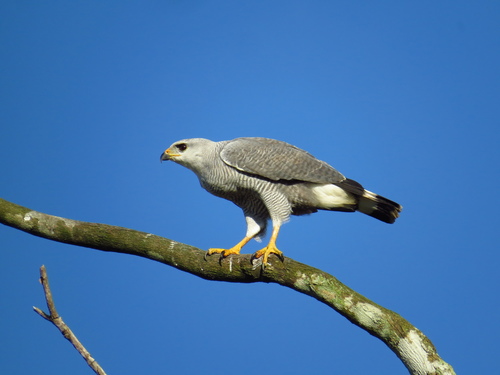
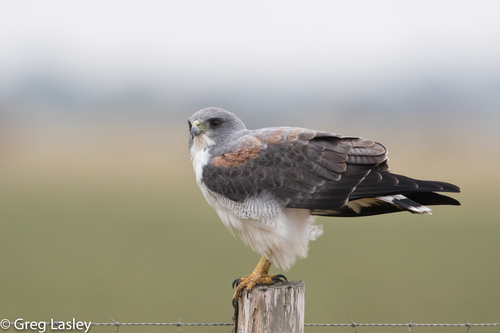
Adult white-tailed hawks are grey on their upperparts, and white on their underparts and rump, with faint pale grey or rufous barring. Their short tail is white, with a narrow black band near the tip that is easily visible during flight. A distinctive rusty-red shoulder patch is visible when the bird perches with its wings closed. The upperwings are dark, mixed with grey near the bases of the blackish primary flight feathers. The underwing is whitish, with indistinct brownish barring on the underwing coverts that extends onto the flanks and thighs. Adults have a hazel iris, pale green cere, black beak with a horn-colored base, and yellow feet with black talons.
Immature white-tailed hawks are darker than adults, and can look nearly black in low light, especially for younger individuals that have little white on their underparts. The wing lining is clearly marked with black-and-white spots, and young birds lack the rusty shoulder patch. As immature birds approach maturity, their tail changes from brown with multiple dark bars to greyish with a faint dark band. The bare parts of immature hawks have the same coloration as those of adults. During the Southern Hemisphere winter, young white-tailed hawks are sometimes misidentified as migrant red-backed hawks (Geranoaetus polyosoma).
The white-tailed hawk's distribution ranges from coastal Texas and the Rio Grande Valley in the United States south to central Argentina, and it also occurs on many Caribbean islands in the Lesser Antilles, as well as on Trinidad and Tobago. It favors open or semi-open habitats up to around 600 m (2,000 ft) above sea level, that have few trees to block its flight. It is not a migratory species, though some populations may make regional movements when food is scarce. It commonly perches on bushes, trees, or telephone poles, stands on the ground, or soars. Overall, it prefers arid habitats and rarely occurs in areas with heavy rainfall. While it may disappear from unsuitable sites after habitat fragmentation, it has a wide geographic range and is not classified as a globally threatened species by the IUCN.
Breeding pairs of white-tailed hawks construct nests from freshly broken twigs, often gathered from thorny plants. Nests are usually placed 1.5–5 m (5–15 ft) or more above the ground in a tree or yucca, ideally in an elevated spot that gives good visibility from the nest. The nest interior is lined with dried grasses and other fine soft materials; green twigs from mesquite or other aromatic plants are often added, which may act to deter parasites. Like many members of the Accipitridae family, white-tailed hawks often reuse nest sites. Nests that are added to over multiple years can grow to up to 1 m (3 ft) across. The eggs are white, often with faint brown or lavender spotting, and clutches contain between one and three eggs, most often two. When a potential intruder approaches the nest, adult white-tailed hawks take to the air and observe the intruder from above. This behavior differs from related hawks, which typically wait longer before flushing and may make direct attacks on intruders.