About Butea monosperma (Lam.) Kuntze
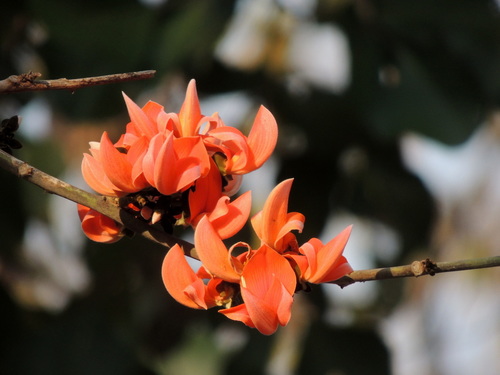
Butea monosperma (Lam.) Kuntze is a small, slow-growing dry-season deciduous tree that reaches up to 15 meters (49 feet) tall. Young trees grow just a few feet each year. Its leaves are pinnate, with a petiole measuring 8 to 16 centimeters (3.1 to 6.3 inches) long and three leaflets; each individual leaflet is 10 to 20 centimeters (3.9 to 7.9 inches) long. The tree’s bright orange-red flowers are 2.5 centimeters (0.98 inches) long, and grow in racemes up to 15 centimeters (5.9 inches) long. Each flower has five petals, two wings, and a keel shaped like a parrot’s curled beak. Blooms are often spectacular and occur between February and April, but the trees do not flower every year. If winter is too cold, too dry, or too rainy, the trees may not produce blossoms. The tree’s fruit is a pod 15 to 20 centimeters (5.9 to 7.9 inches) long and 4 to 5 centimeters (1.6 to 2.0 inches) wide. This plant is used to produce timber, resin, fodder, medicine, and dye. Its wood is dirty white and soft, and is durable under water, so it is used for well curbs and water scoops. Spoons and ladles made from this wood are used in various Hindu rituals to pour ghee into fire, and the wood can also be processed into good charcoal. Farmers commonly plant these trees along field bunds to reduce soil erosion. Young shoots are grazed by buffaloes as fodder. In the past, leaves were used as disposable serving platters, a purpose now filled by plastic plates. In Ayurvedic tradition, consuming Palash Sharbat, a drink made from this plant, is said to help the body withstand heat and may support general health. Some modern research has noted its antioxidant content, but robust clinical evidence for this is currently limited. Fixed oil found in the plant’s seeds and the glucoside butrin found in flower sap are considered poisonous. Consumption of these compounds may cause dizziness, headache, and hypotension. For culinary use, the gum from this tree, called kamarkas in Hindi, is added to certain food dishes. In the Indian state of Maharashtra, a flower tea is made from the plant as a summer beverage, which is considered to have medicinal benefits.