About Butastur rufipennis (Sundevall, 1850)
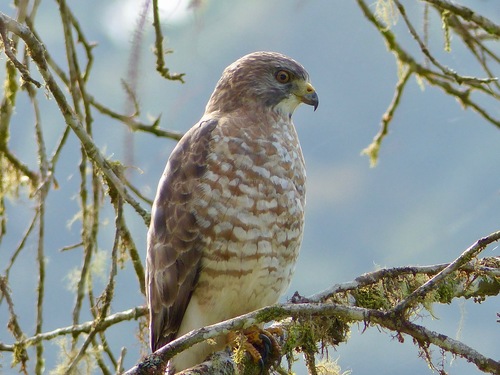
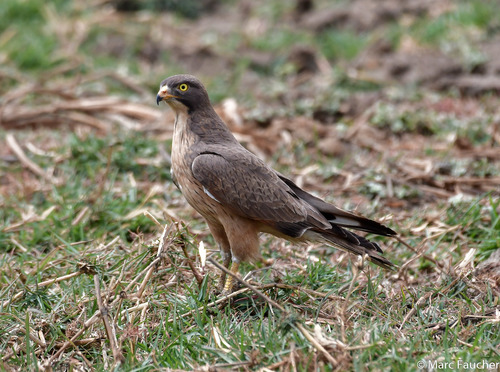
This bird species, commonly called the grasshopper buzzard, has the scientific name Butastur rufipennis (Sundevall, 1850). Adult grasshopper buzzards are grey-brown on their upper bodies, with darker heads and dark shaft streaks across all their feathers. When their plumage is fresh, the feathers of the mantle and lesser coverts have narrow rufous fringes, though this marking wears away over time. The grey tail has faint brown bars. The greater coverts and primary feathers are light rufous, and primaries are tipped with black, forming a noticeable reddish patch when the bird is in flight. Secondary feathers are rufous, shading to dark brown towards the white tip. The chin and throat are whitish, with three black streaks on each side of the throat. The breast is rufous and has narrow black shaft streaks; the belly and thighs are also rufous but have no markings. Axillary feathers are greyish brown, spotted with white or buff. Under wing coverts and wing lining are white. The eyes, legs, and cere are yellow. The bill has a black tip and a yellow base. Females are slightly larger than males. Juveniles have a bright brownish-red head and nape with dark shaft streaks. As they age, their crown matches the colour of the back, their tail develops bars, and the rufous edges on the mantle and coverts become less distinct. The grasshopper buzzard measures 30–35 cm (12–14 in) in length, with a wingspan of 90 cm (35 in). Males weigh 310–340 g (11–12 oz), while females weigh 300–380 g (11–13 oz). Grasshopper buzzards most commonly occupy woodland, forest edges, and arid acacia savannahs. They can also be found at marsh edges and over burnt areas. This is an Afrotropical species. Its range extends east from Senegal and Gambia to Ethiopia, and it migrates south to Sierra Leone, Cameroon, northeastern Democratic Republic of Congo, Kenya, and northern Tanzania.