About Busarellus nigricollis (Latham, 1790)
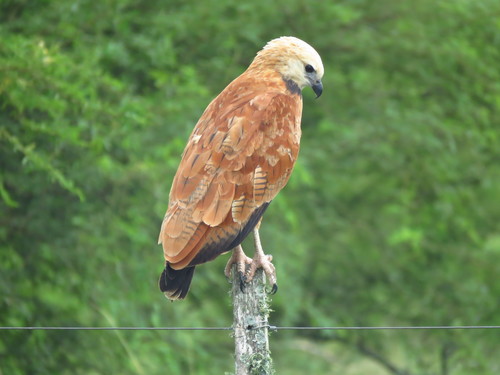
The black-collared hawk, scientifically named Busarellus nigricollis (Latham, 1790), is a bird of prey species in the Accipitridae family. It is the only species in the monotypic genus Busarellus. This hawk has a widespread distribution, ranging from western Mexico to Uruguay. Its natural habitats include subtropical or tropical moist lowland forests, and subtropical or tropical swamps. Adult black-collared hawks have a mostly white head with a buff tinge, and black shaft streaks on the crown. The upper and lower body, along with the mantle, are bright cinnamon-rufous, with a paler shade on the chest. A black crescent marking is present on the upper breast. The back has scattered black shaft stripes; the flight and tail feathers are black, while the base of the tail is barred with rufous. The eyes are bright reddish brown, the cere and bill are black, and the legs are bluish white. Immature black-collared hawks are similar in overall appearance to adults, but have black blotching including on the crown, more extensive rufous barring on the tail, and a more clearly marked pale chest area. The upper surface of the wings is barred, and the eyes are brown. The nest of the black-collared hawk is typically built in a large tree, most often near water, but it may sometimes be placed in shade trees in coffee plantations or suburban areas. The nest is lined with green leaves. Females lay three to five dull white eggs, spotted with pale yellow-brown or red-brown and marked with a few darker freckles. No additional information about the species' reproduction is available. The black-collared hawk's diet consists mainly of fish. It also eats water bugs, and occasionally consumes other large insects, snakes, lizards, frogs, snails, other molluscs, crustaceans, small birds and their nestlings, rodents, and other small mammals. In the 1870s, Ridgeway noted that Busarellus, then called Ichthyoborus, shared the "general form and appearance of Buteogallus aequinoctialis", but was much more closely related to the heliatine groups, which he classified to include Milvus, Haliastur, and Haliaaetus. From the early to mid 20th century, Busarellus was conventionally placed near Buteogallus in taxonomic ordering. The black-collared hawk has fused basal phalanges on its inner toe; this feature may be an adaptation to stop the toe from bending backward when catching prey. The same trait is shared with Ictinia and the group of true milvine kites and sea eagles, which includes Milvus, Haliastur, Haliaaetus, and Icthyophaga. Early 21st century molecular phylogenetic research shows that a distinct milvine–haliaetine clade is related to a large group of buteonine hawks and their relatives. Within the buteonine group, Ictinia is near-basal, and Busarellus belongs to a clade it shares with Geranospiza, Rostrhamus, and Helicolestes.