About Bulbophyllum longiflorum Thouars
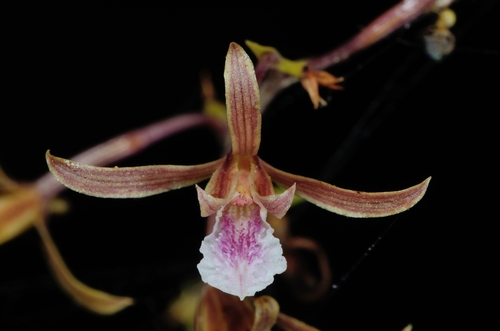
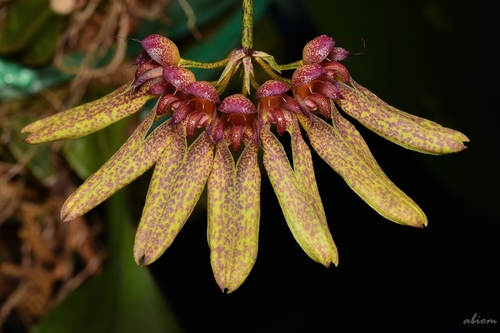
Bulbophyllum baileyi, also known as the pale umbrella orchid, is an epiphytic or lithophytic herb. It has a creeping rhizome and grooved, dark green pseudobulbs that measure 30–45 mm (1–2 in) long and 15–20 mm (0.59–0.79 in) wide. A single fleshy, dark green leaf grows at the end of each pseudobulb, 80–150 mm (3–6 in) long and 20–30 mm (0.79–1.2 in) wide. Between five and eight flowers are arranged in a spreading, semi-circular umbel 100–200 mm (3.9–7.9 in) long, with each flower growing on a 15–20 mm (0.59–0.79 in) long pedicel. The flowers are resupinate, greenish cream to yellowish with purple spots or dots, 30–40 mm (1.2–1.6 in) long and 3–5 mm (0.12–0.20 in) wide. The dorsal sepal is egg-shaped, 6–8 mm (0.24–0.31 in) long and 4–5 mm (0.16–0.20 in) wide, forming a hood over the column, with a long, hair-like tip at its end. The lateral sepals are 25–35 mm (0.98–1.4 in) long and 3–5 mm (0.12–0.20 in) wide, and are fused to each other along their sides. The petals are triangular, curved, 6–18 mm (0.24–0.71 in) long and 4–5 mm (0.16–0.20 in) wide. The labellum is dark purple, fleshy, curved, 4–5 mm (0.16–0.20 in) long and about 2 mm (0.08 in) wide, with a groove running along its midline. Flowering occurs between January and March in Australia, between October and January in Africa, and throughout the year in New Guinea. This orchid is distributed across Africa, Madagascar, the Mascarenes, the Seychelles, Malaysia, New Guinea, New Caledonia, Fiji, the Society Islands, the Austral Islands, and Queensland, Australia. In Queensland, it grows in the Iron and McIlwraith Ranges. It inhabits rainforests and hill forests at elevations from sea level to 1,700 metres (5,600 ft).