About Bulbophyllum baileyi F.Muell.
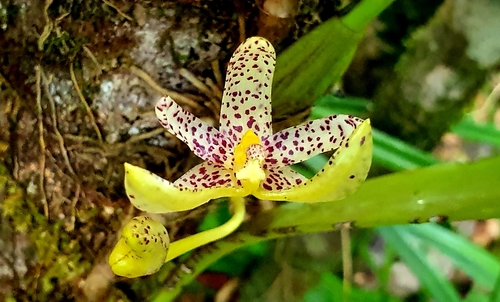
Bulbophyllum baileyi F.Muell. is an epiphytic or lithophytic herb that forms spreading clumps. It has a creeping rhizome covered with brown bracts, and curved, yellowish pseudobulbs that measure 15–30 mm (0.6–1 in) long and 10–15 mm (0.39–0.59 in) wide. Each pseudobulb ends in a single oblong or egg-shaped, thick, fleshy, light-coloured leaf, 80–200 mm (3–8 in) long and 40–60 mm (1.6–2.4 in) wide. A single upward-facing flower, cream-coloured to creamy yellow with red or purple spots, 20–25 mm (0.79–0.98 in) long and 20–40 mm (0.79–1.6 in) wide, grows on a 60–100 mm (2.4–3.9 in) long flowering stem. The sepals and petals curve inwards. The dorsal sepal is narrow triangular, 20–25 mm (0.79–0.98 in) long and 4–5 mm (0.16–0.20 in) wide; the lateral sepals are a similar length but 6–7 mm (0.24–0.28 in) wide. The petals are 15–18 mm (0.59–0.71 in) long and 4–5 mm (0.16–0.20 in) wide. The labellum is fleshy and curved, 5–6 mm (0.20–0.24 in) long, about 3 mm (0.1 in) wide, and marked with tiny spots. Flowering mainly occurs between October and February. Commonly called the fruit fly orchid, this species grows on trees, rocks and cliff faces in mangroves, rainforest and open forest. It is found in New Guinea, some Torres Strait Islands, and Cape York Peninsula in Queensland, Australia, ranging south as far as Townsville. The flowers of B. baileyi are pollinated by male fruit flies of the genus Bactrocera, which are attracted to the flowers by their "fruity" fragrance. It has been suggested that the flies seek zingerone from the flowers, which the flies use as a sexual attractant. The flower's labellum is delicately hinged; when an insect lands on it, the labellum tips the insect into the floral column. This movement results in sticky pollinia attaching to the fly's back, or the fly deposits existing pollinia on the receptive stigma.