About Bulbinella rossii (Hook.f.) Mottet
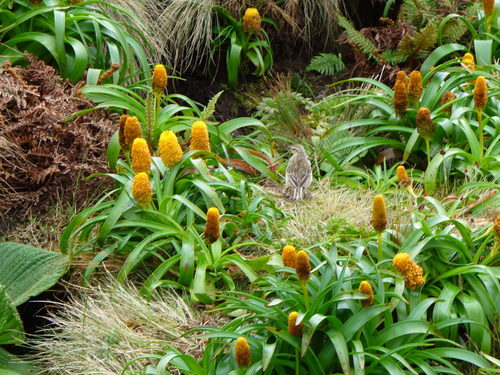
Bulbinella rossii (Hook.f.) Mottet is a large, dioecious megaherb belonging to the family Asphodelaceae and subfamily Asphodeloideae. It can grow up to 1 metre in height, with a basal diameter of 40 mm. Its leaves are dark green, fleshy, smooth, and strap-shaped, measuring 0.6–1 m in length and 15–60 mm in width. The inflorescence (flower cluster) is a cylindrical raceme that can reach 600 mm in length. The species produces densely packed golden yellow flowers that are 10–14 mm in diameter. It forms ovoid (oval) seed capsules 10 mm long, which hold narrowly winged, dark brown seeds. B. rossii flowers from October to January, and fruits from December to March. In male specimens, ovaries remain undeveloped. In female specimens, tepals spread to an approximately 11–12 mm diameter, are more erect and persistent, and become firmer in texture as fruit ripens; female seed capsules are broadly ovoid, and their seeds are 6 mm long. Young flower buds and freshly opened blooms of B. rossii are packed more tightly than older flowers, a trait that may contribute to heat retention within the inflorescence. A 2016 study published in Polar Research hypothesizes that the warmth generated by the inflorescences helps attract insects in the generally cold sub-Antarctic climate, where average temperatures reach 6.88 °C (44.38 °F). Most Bulbinella species are predominantly endemic to South Africa, but six species are endemic to New Zealand, most of which are found primarily in the South Island. B. rossii is endemic to New Zealand's subantarctic Auckland Islands and Campbell Islands. It is common and widespread there from sea level to the highest mountain elevations of the islands. Because it thrives in disturbed ground and is not preferred by browsing animals, it is common near former human habitation sites, and can form dense colonies in open herbfields and tussock grasslands. In a 1970 study of Enderby Island's vegetation and wildlife conducted by botanist R. H. Taylor, B. rossii was noted to be more common on the north and west sides of the island, while the south-east side was dominated by southern rātā (Metrosideros umbellata) forest. All New Zealand Bulbinella species are allopatric, and prefer colder habitats and soils with high water content. On the main Auckland Island, B. rossii occurs from sea level to high-altitude areas, but is uncommon at lower altitudes. It is more common at higher altitudes, where the ground conditions are unfavourable for rooting by introduced animals. On Campbell Island, B. rossii only becomes predominant above 250–300 m (820–980 ft) above sea level. In terms of ecological interactions, the roots of B. rossii are often eaten by pigs, but the species is avoided by cattle and goats. Its bitter taste also makes it unappealing to sheep. In 1910, M. McKay, a stock inspector visiting Campbell Island to report on cases of sheep scab to New Zealand's Ministry of Agriculture, noted that B. rossii was so common on the island that it resembled an invasive species. A 2013 research article in the New Zealand Journal of Botany reported on floral biology and pollination on Campbell Island. Researchers observed many individuals of Campbell Island wētā (Notoplectron campbellensis) feeding on the pollen and nectar of B. rossii, with as many as eight wētā individuals on a single inflorescence. In their study, B. rossii was the most frequently visited plant species. Other insect species recorded visiting B. rossii in this study included Melangyna novaezelandiae and Scoparia parmifera. B. rossii is also known to be visited by hoverflies and other small flies. A 2019 study published in Polar Research that examined moths on New Zealand's subantarctic islands noted that Ichneutica erebia, an endemic moth, was observed visiting B. rossii inflorescences and may be an important pollinator for the species. I. erebia moths either actively seek out B. rossii, or are capable of travelling long distances at night and engaging in more active foraging. The seeds of B. rossii are dispersed by wind.