About Bulbinella gibbsii Cockayne
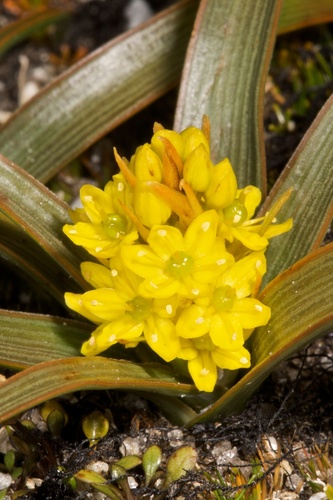
Bulbinella gibbsii Cockayne is a subdioecious perennial herb belonging to the family Asphodelaceae and subfamily Asphodeloideae. The nominate variety reaches a maximum height of 300 mm, while Bulbinella gibbsii var. balanifera can grow up to 600 mm tall, with slightly longer peduncles and pedicels than the nominate variety. This species has tuberous roots. Its leaves are strap-shaped, up to 30 mm wide, and range in colour from reddish-green to dark green. Its racemes are usually conical, sometimes cylindrical, with a visible central axis between individual flowers. The pedicels are 10–20 mm long. The dark yellow flowers measure 10–14 mm across, and typically have six tepals with anthers that contain pollen.
Bulbinella gibbsii is endemic to New Zealand. The nominate variety, Bulbinella gibbsii var. gibbsii, is restricted to Stewart Island, while var. balanifera is more widespread across the North and South Islands. In the North Island, var. balanifera occurs only in the Tararua Ranges and the southern part of the Ruahine Ranges. In the South Island, var. balanifera is more common, and grows from Arthur's Pass south to Fiordland. In the 2023 New Zealand Threat Classification System assessment, Bulbinella gibbsii var. gibbsii is listed as "At Risk — Naturally Uncommon", while Bulbinella gibbsii var. balanifera is listed as "Not Threatened".
Bulbinella species native to New Zealand favour colder habitats and soils with high moisture content. Bulbinella gibbsii var. gibbsii usually grows in boglands and subalpine areas, and is occasionally found in ponds and small natural pools. It occurs from near sea level up to nearly the summit of Mount Anglem. It is typically found at elevations above 490 m (1,600 ft), but is also abundant near sea level. Bulbinella gibbsii var. balanifera grows in alpine environments, most commonly in tussock grasslands and occasionally in subalpine scrublands, and can reach elevations of 1,400 m (4,500 ft). It is commonly found growing alongside Chionochloa oreophila and Chionochloa pallens.
Although Bulbinella gibbsii is locally abundant in Fiordland, a main distribution area of the flightless endemic New Zealand bird takahē (Porphyrio hochstetteri), this plant is not a preferred food source for takahē. A separate study has recorded that Bulbinella gibbsii is eaten by red deer (Cervus elaphus). It is thought that this species is pollinated by insects including bees and flies, and its seeds are dispersed by wind.
Evidence from a 1971 study indicates that the indigenous Māori people of New Zealand wove leaves of Bulbinella gibbsii var. balanifera into plaited baskets and floor mats. Academic literature and surviving artefacts record no other uses of any Bulbinella species by Māori.