About Bulbinella angustifolia (Cockayne & Laing) L.B.Moore
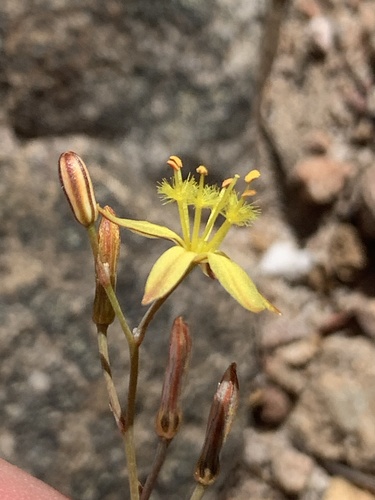
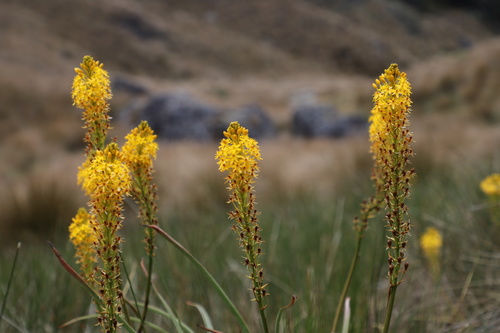
Bulbinella angustifolia (Cockayne & Laing) L.B.Moore is a species of perennial herb belonging to the family Asphodelaceae and subfamily Asphodeloideae. This species grows up to 100 cm (40 in) tall. Its leaves are typically smooth, and narrow toward a pointed tip; the longest recorded leaf of the species measures 60 cm (20 in) in length, while the widest recorded measures 15 cm (6 in) across. B. angustifolia has small perianths, and produces yellow flowers. Its peduncles measure 5–55 mm by 1–10 mm, its racemes measure 2.5–20 cm by 1.5–2.5 cm, and its pedicels are most often around 15 mm long, though they can reach up to 20 mm. Its capsules measure 5–7 mm by 4 mm, and its infructescences (fruit clusters) usually grow arranged above the leaves. The seeds of B. angustifolia are roughly 4–4.5 mm long. This species is endemic to the South Island of New Zealand. Its range extends south from around the Hurunui River in the Canterbury Region, through the Canterbury Plains, Otago, and the Southland Region, and it does not occur west of the Southern Alps. In the 2023 New Zealand Threat Classification System assessment, B. angustifolia is classified as "Not Threatened". All Bulbinella species native to New Zealand prefer colder habitats and soils with high water content. B. angustifolia is typically found in damp environments including boglands, seepages, and steep shaded slopes, and grows most often in tussock grasslands, where it is frequently locally abundant. It is common in areas with moderate moisture levels, and is often found growing alongside Chionochloa rubra. A 1996 study recorded that B. angustifolia is grazed by introduced European rabbits (Oryctolagus cuniculus), though the amount of grazing on this species is lower than that recorded for other species at the study site in Central Otago. B. angustifolia is thought to be pollinated by insects, including bees and flies, and its seeds are dispersed by wind.